Supplemento S86 - Editorial

Peritoneal dialysis in patients with heart failure – The Italian reality based on the Census 2024 of the Peritoneal Dialysis Project Group of the Italian Society of Nephrology

Abstract

Peritoneal dialysis has shown to reduce days of hospitalization, NYHA functional class and to improve slightly left ventricular ejection fraction in heart failure patients. For the first time, the nationwide 2024 Census of the Peritoneal Dialysis Project Group of the Italian Society of Nephrology is able to analyze and to confront heart failure patients treated by peritoneal dialysis to a time-matched cohort of chronic kidney disease patients under peritoneal dialysis.

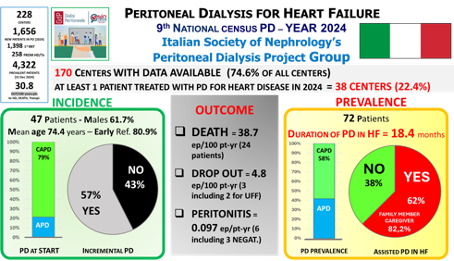
The census data of 170 Italian dialysis centers are presented. 1063 patients started peritoneal dialysis for kidney disease whereas 47 patients for heart failure, resulting in a prevalence of 3371 kidney disease patients and 72 heart failure patients in 2024. Heart failure patients presented higher age and male prevalence. CAPD was mainly used as dialysis start modality in heart failure patients (78.7%) with incremental dialysis prescription more often applied and assisted dialysis more often needed.

Mean duration of peritoneal dialysis was 31.3 months in kidney disease patients, whereas 17.6 months in heart failure patients, mainly due to a 4-fold increased risk of death. The peritonitis risk was lower in heart failure patients with 0.097 episodes / patient-year compared to 0.166 episodes / patient-year in kidney disease patients.

The census results confirm that peritoneal dialysis for heart failure is a feasible time-limited therapeutic opportunity for a known high-risk population of mostly elderly, male and frail patients requiring assisted dialysis.

KEYWORDS: peritoneal dialysis, chronic kidney disease, heart failure, survival, peritonitis, census
Introduction

Peritoneal dialysis (PD) is a dialysis modality characterized by a lower impact on quality of life and continuity of treatment, making it the ideal modality for complex patients. In recent years, there has been an epidemiological change especially in Europe. Patients who are approaching to dialysis are increasingly elderly and have multiple comorbidities, especially cardiovascular ones [1, 2]. This is partly due to the improvement in the treatment of comorbidities such as cardiovascular ones. Generally, the use of PD appears to remain anchored to relatively young, autonomous and much less frail patients. Data from the latest Italian Peritoneal Dialysis Census and from other European registries report an average patient age of approximately 64 years and application of assisted PD in only 21% of the prevalent patients [1–4]. Several single-center studies and systematic literature reviews evidenced good results of PD treatment in patients with refractory heart failure [5–13]. However, there are few data regarding real-life application of PD in heart failure patients beyond clinical, observational studies. Up to now, results of two national registries from Spain and Germany analyzing patients with heart failure under PD therapy have been published [7, 8]. For the first time, the nationwide 2024 Census of the PD Project Group of the Italian Society of Nephrology is able to analyze these heart failure patients treated by PD separately, and to confront these patients to a time-matched chronic kidney disease peritoneal dialysis cohort.

Materials and Methods

Approximately every 2 years, the PD Project Group of the Italian Society of Nephrology coordinates a nationwide census on PD therapy [3–4]. Several items are regularly analyzed such as the indication of PD start, the incidence, prevalence, peritonitis rate, drop out, the application of assisted or incremental PD, PD modality type such as automated peritoneal dialysis (APD) or continuous ambulatory peritoneal dialysis (CAPD), encapsulating peritoneal sclerosis and information regarding the management and structure of the local PD programs.

The PD centers regularly enter data in dedicated software, a sort of electronic medical record of PD patients, or fill out an online questionnaire in the case of unavailability of the software. For the protection of privacy, the software was developed without a cloud component, so all data collected are stored locally at the center. Subsequently, these data are exported in aggregate form. Applying a new software starting in 2024 it was possible to extract in an anonymous way data regarding the afore-mentioned parameters. By this way it was possible to analyze separately patient data for whom PD was started for heart failure. For those who did not or were not able to use the dedicated software, data was sent only in aggregate form. The results of the most recent PD census, referred to 2024, have been published recently in August 2025 including a detailed description of data collection methods [3].

The definition of PD therapy for cardiac indication was heart failure refractory to diuretic therapy or cardiorenal syndrome type 2. All dialysis facilities with at least one PD patient contributed to data collection. In total, nationwide all 228 centers submitted Census data, of these 58 centers only in the aggregate form, whereas the remaining 170 PD centers utilized the 2024 software version allowing anonymized data extraction. For the descriptive and statistical analysis regarding heart failure patients under PD therapy only the latter 170 centers were taken into consideration.

PD incidence was always referred to the calendar year including all patients starting dialysis between January 1 and December 31, whereas prevalence was referred to patients treated at the end of the year, December 31.

Late referral was defined as first nephrology visit less than 3 months before PD therapy start; incremental PD prescription was defined as 1–2 exchanges per day for CAPD and 1–4 sessions/week for APD, respectively.

Descriptive statistics of variables with continuous distribution was performed using Mann-Whitney T-test for the analysis of differences between CKD and heart failure group. Chi square Test was used for the comparison of case frequencies between the CKD and heart failure group.

Results

Incident patients

In the 170 Centers of the 2024 Census, allowing anonymized data extraction, 1063 patients started PD for CKD whereas 47 patients for heart failure. The mean age of incident heart failure patients was 74.4 years compared to CKD patients with 65.5 years (p < 0.05). Both groups presented a male prevalence (63.9% male patients in the heart failure group, respectively 61.7% in the CKD group). The late referral rate in heart failure patients was 19.1% compared to CKD patients with 6.4% (p < 0.01).

CAPD was mainly used as PD start modality in both groups, but with a significantly higher proportion in heart failure patients (78.7% versus 53.5%, p < 0.01). Furthermore, an incremental PD prescription was more often applied in heart failure patients compared to CKD patients (57.4% versus 37.4%, p < 0.01).

The PD catheter was positioned by the nephrologist alone in 20.3% of the CKD patients and in 17.0% of heart failure patients, whereas in all other cases by the surgeon alone or by the surgeon in collaboration with the nephrologist.

Prevalent patients

At December 31 2024, a total of 3371 CKD patients were treated by PD, whereas 72 heart failure patients. Gender distribution was similar between the two groups (62.2% males in the CKD group versus 66.7% in the heart failure group).

CAPD was mostly applied in prevalent heart failure patients with 58.3% compared to 42.9% in CKD patients (p < 0.01). Among the prevalent heart failure patients, 62.5% were under assisted PD compared to 19.7% in CKD patients (p < 0.01). The caregivers involved was in both groups mainly a family member (82.2% in heart failure patients versus 87.2% in CKD patients, n.s.).

The entry / prevalent ratio, an indicator of population turnover, was 2.61 for CKD patients and 1.47 for heart failure patients (p < 0.01), corresponding to a mean duration of PD of 31.3 months and 17.6 months, respectively.

Patient outcome

During the year 2024, 393 patients in the CKD group were transferred to hemodialysis (12.2 episodes / 100 patient-years) compared to only 3 cases in the heart failure group (4.8 episodes / 100 patient-years). The dialysis therapy shift to hemodialysis in the CKD group was mainly due to peritonitis (84 patients), mechanical catheter problems (68 patients), ultrafiltration failure (54 patients) and PD adequacy problems (47 patients), whereas in the heart failure group the shift to hemodialysis was due to peritonitis (1 patient) and ultrafiltration failure (2 patients).

In the CKD group 303 patients died (9.4 episodes / 100 patient-year) whereas in the heart failure group 24 patients (38.7 episodes / 100 patient-years, p < 0.01). A cardiovascular cause of death was indicated in the CKD group in 38.7%, whereas in the heart failure group in 70.8% (p < 0.01).

289 transplantations (9.0 episodes / 100 patient-years) were recorded in the CKD group against only one case among heart failure patients.

Overall, the PD drop-out rate was 30.6 episodes / 100 patient-years in the CKD group versus 45.2 episodes / 100 patient-years in the heart failure group.

In the CKD group, 535 episodes of peritonitis were observed, of which 90 were culture-negative (16.8%), whereas 6 episodes in the heart failure group, of which three were culture-negative (50%), corresponding to an incidence of 0.166 episodes / patient-year in the CKD group (one peritonitis episode every 72.3 treatment months), and of 0.097 episodes / patient-year in the heart failure group (one peritonitis episode every 124 treatment months).

Participating centers

There were 39 of 170 centers (22.9%) that treated at least one heart failure patient with PD in 2024. These centers are characterized by a greater number of prevalent patients (25.4 patients/center) compared to centers which do not treat heart failure patients (18.2 patients/center) and by a tendentially greater use of assisted PD (5.3 patients/center vs 3.5 patients/center) even if the percentage of assisted PD was similar in both groups of PD centers (application of assisted PD for all patients in centers treating heart failure patients 20.8% versus centers without heart failure patients 19.2%). In centers applying PD for heart failure patients, the incidence and prevalence of heart failure for PD initiation compared to the total number of patients in PD are 15.7% and 7.3%, respectively.

Discussion

For the first time it was possible to describe the characteristics, the treatment modalities and long-term outcome of heart failure patients treated by PD in Italy. These are elderly patients who require a caregiver in two-thirds of cases; incremental CAPD is the start modality as they need mainly peritoneal ultrafiltration. Precedingly, in 2025 the results of the Catalan registry including 198 heart failure patients on PD (registry data from 2013 to 2022) and in 2019 the results of the registry of the German Society of Nephrology including 159 heart failure patients on PD (registry data from 2010 to 2014) have been published [7–8]. The afore-mentioned national registries together with recent studies and meta-analyses confirm the advanced patient age (mostly mean age above 70 years), male prevalence (mostly above 70%) and prevalent application of CAPD in heart failure patients treated by PD [5–8].

The average duration of PD of heart failure patients, corresponding basically to the survival of these patients, is quite time-limited to about 18 months in our nation-wide analysis. The reported average survival on PD of heart failure patients varies between 13.3 [9] and 36.5 months [8, 10] in recent studies. The wide timespan differences seem to be related mainly to the different patient characteristic and inclusion criteria applied. Generally, the high cardiovascular risk profile, the age and the frailty of these patients has to be taken into consideration. In our census report patients with heart failure present a non-adjusted three-fold increased need of assisted PD and a four-fold increased risk of death compared to CKD patients.

The incidence of peritonitis is progressively decreasing according to the Italian census evaluations [3–4]. The peritonitis rate is even lower in heart failure patients with 0.097 episodes / patient-year compared to CKD patients with 0.166 episodes / patient-year. This might reflect the special attention and training given to these patients and their caregivers. The peritonitis rate in recently published heart failure studies varies between 0.1 and 0.325 episodes / patient-year [11–13]. The systematic review of Chionh CY et al. [6] including 31 studies from the year 1966 to 2017 report peritonitis rates of 0.02 up to 0.46 episodes / patient-year (mostly between 0.02 and 0.27 episodes / patient-year), whereas the systematic review and meta-analysis of Timóteo AT et al. [5] including 10 observational studies published before July 2020 mention a range of 0 to 0.75 peritonitis episodes / patient-year (mostly below 0.32 episodes / patient-year). Thus, PD in heart failure patients seems to be a safe technique regarding infectious complications despite presence of intestinal venous congestion theoretically favoring bacterial transmigration from the intestine. The incidence of peritonitis and ultrafiltration failure apparently are not limiting the application PD in heart failure patients.

The PD center size reflects the general experience of the PD staff, that is why PD was offered to heart failure patients especially in centers with a higher number of prevalent PD patients.

The census evaluation has several limitations: we are unable to analyze in detail the different causes of heart failure and the prevalence of different comorbidities. Furthermore, we cannot provide eGFR, ultrafiltration, pharmacological therapy data and hospital re-admission rates. A multifactorial risk analysis of PD dropout is not possible.

Conclusions

The 2024 census of the Peritoneal Dialysis Project Group of the Italian Society of Nephrology confirms that PD for heart failure is a feasible time-limited therapeutic opportunity for a known high-risk population of mostly elderly, male and frail patients requiring assisted PD.


References

  1. Slon-Roblero MF, Stel VS, Sanchez-Alvarez E, et al. Trends in home dialysis over the last decade in Europe: an ERA Registry study. Nephrol Dial Transplant. 2025 Aug 29:gfaf171. https://doi.org/10.1093/ndt/gfaf171
  2. Boenink R, Bonthuis M, Boerstra BA, et al. The ERA Registry annual report 2022: Epidemiology of kidney replacement therapy in Europe, with a focus on sex comparisons. Clin Kidney J. 2024 Dec 12;18(2):sfae405. https://doi.org/10.1093/ckj/sfae405
  3. Neri L, Giuliani A, Heidempergher M, et al. Peritoneal dialysis in Italy: the 9th GPDP-SIN Census 2024. Twenty years of monitoring peritoneal dialysis. G Ital Nefrol. 2025 Aug 29;42(4):2025-vol4. https://doi.org/10.69097/42-04-2025-02
  4. Neri L, Viglino G, Vizzardi V, et al. Peritoneal dialysis in Italy: the 8th GPDP-SIN census 2022. G Ital Nefrol. 2023 Jun 29;40(3):2023-vol3.
  5. Timóteo AT, Mano TB. Efficacy of peritoneal dialysis in patients with refractory congestive heart failure: a systematic review and meta-analysis. Heart Fail Rev. 2023 Sep;28(5):1053-1063. https://doi.org/10.1007/s10741-023-10297-3.
  6. Chionh CY, Clementi A, Poh CB, Finkelstein FO, Cruz DN. The use of peritoneal dialysis in heart failure: A systematic review. Perit Dial Int. 2020 Nov;40(6):527-539. https://doi.org/10.1177/0896860819895198
  7. Núñez-Delgado S, Azancot MA, Méndez Fernandez AB, et al. Long-term impact of peritoneal dialysis ultrafiltration on cardiorenal patients. Cardiorenal Med. 2025;15(1):560-571. https://doi.org/10.1159/000546924
  8. Grossekettler L, Schmack B, Meyer K, et al. Peritoneal dialysis as therapeutic option in heart failure patients. ESC Heart Fail. 2019 Apr;6(2):271-279. https://doi.org/10.1002/ehf2.12411
  9. Kunin M, Klempfner R, Beckerman P, Rott D, Dinour D. Congestive heart failure treated with peritoneal dialysis or hemodialysis: Typical patient profile and outcomes in real-world setting. Int J Clin Pract. 2021 Mar;75(3):e13727. https://doi.org/10.1111/ijcp.13727
  10. Sahin E, Gökçay Bek S, Eren N, et al. Usefulness of peritoneal ultrafiltration in patients with diuretic resistant heart failure without end-stage renal disease. Cardiorenal Med. 2020;10(6):429-439. https://doi.org/10.1159/000510249
  11. Kunin M, Mini S, Abu-Amer N, Beckerman P. Regular at-home abdominal paracentesis via Tenckhoff catheter in patients with refractory congestive heart failure. Int J Clin Pract. 2021 Dec;75(12):e14924. https://doi.org/10.1111/ijcp.14924
  12. Papasotiriou M, Liakopoulos V, Kehagias I, et al. Favorable effects of peritoneal dialysis in patients with refractory heart failure and overhydration. Perit Dial Int. 2022 Jan;42(1):48-56. https://doi.org/10.1177/0896860820970097
  13. Pavo N, Yarragudi R, Puttinger H, et al. Parameters associated with therapeutic response using peritoneal dialysis for therapy refractory heart failure and congestive right ventricular dysfunction. PLoS One. 2018 Nov 19;13(11):e0206830. https://doi.org/10.1371/journal.pone.0206830