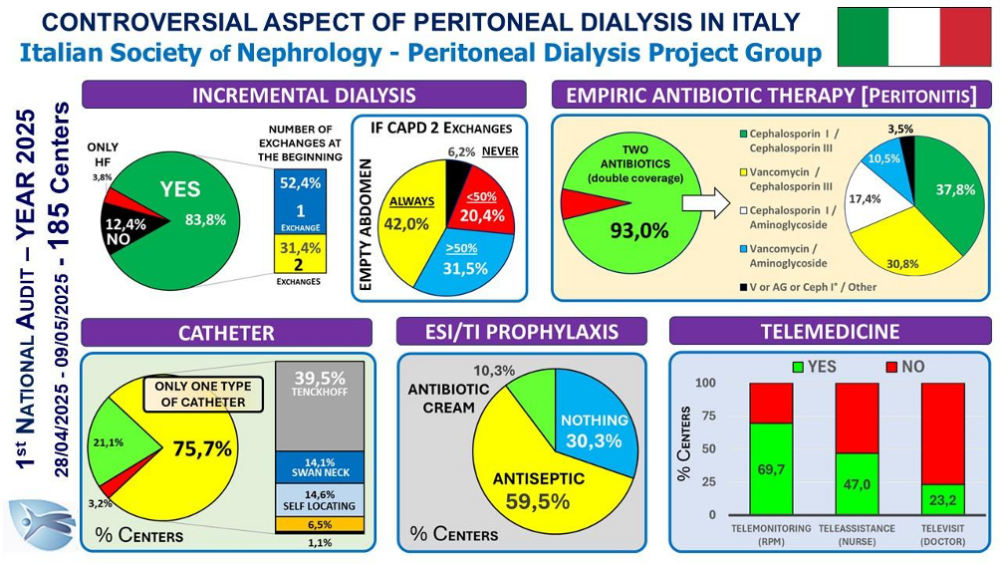
Controversial Aspects of Peritoneal Dialysis in Italy. Results of the First National Audit of PD

Abstract

The Census carried out by the Italian Society of Nephrology’s Peritoneal Dialysis (PD) Project Group has been following the evolution of PD for 20 years. For the first time, the latest edition in 2024 was followed up by an on-line audit conducted between 28/04/2025 and 09/05/2025.
With 185 of the 228 Centers which used PD in 2024 taking part, the Audit investigated a number of questions which are controversial or relatively unexplored: 1) the incremental dialysis prescription in CAPD; 2) empiric peritonitis therapy; 3) the prophylaxis of exit site infections (ESI); 4) types of peritoneal catheter used; 5) the use of telemedicine.
There is no consensus on the incremental prescription in CAPD. Most start with a single exchange, and in the event of two exchanges the majority keep the abdomen empty for part of the day. However, 37.4% of the 162 Centers using incremental PD begin from 2+ exchanges, while 26.5% in two-exchange CAPD keep the abdomen always full. A fair degree of variation was also observed regarding the type of catheter used, although 75.7% of the Centers use only one type in their Center.
Almost all the Centers follow ISPD recommendations on empiric peritonitis therapy and ESI/TI prophylaxis, the validity of which is confirmed by the constant reduction in the drop-out rate for peritonitis recorded over the last 20 years.
Finally, Telemedicine data show the ever-increasing use of this tool, notably Telemonitoring, whereas only a minority of the Centers use Teleassistance – in particular Televisits – which is particularly useful in Assisted PD.

Keywords: Peritoneal Dialysis, Incremental Dialysis, Peritonitis, Exit Site Infections, Peritoneal Catheter, Telemedicine

Background

The Census by the Italian Society of Nephrology’s Peritoneal Dialysis Project Group (GPDP-SIN) collects data on various aspects of Peritoneal Dialysis (PD); launched in 2005, it has essentially been following the evolution of PD for 20 years, with the ninth edition relating to 2024 being the latest [1].

The most significant data observed by the Census over these 20 years have been: 1) a continuous and constant reduction in the incidence of peritonitis and drop-outs for peritonitis, 2) an increasingly widespread use of the incremental prescription, with CAPD (Continuous Ambulatory Peritoneal Dialysis) always being associated with incremental prescription and APD (Automated Peritoneal Dialysis) with full dialysis, 3) an ever more extensive use of 3.86% PET in the evaluation of the peritoneal membrane, 4) an increasingly minor role of the Nephrologist in the placement of the peritoneal catheter, 5) a constant reduction – still under discussion – in the incidence of EPS. Despite these results, the number of Centers using PD, its prevalence and mean duration, overall drop-out rates and the percentage of patients on Assisted PD have remained largely unchanged.

In order to attempt to clarify some of these aspects, the latest edition of the Census was followed up with an on-line Audit, the results of which are reported in this paper.


Materials and methods

Methodology and implementation

A questionnaire was sent to all the contacts in the 228 Centers which took part in the 2024 Census following the rule “only one response per Center”. The subject areas investigated in the Audit were drawn from a preliminary analysis of the Census data. The issues were selected and the questions were formulated by all the Authors during videoconferencing meetings, and the Audit was conducted between 28/04/2025 and 09/05/2025. The results of preliminary processing were presented at the XXII National Peritoneal Dialysis Conference held in Brescia from 15 to 17 May 2025. In order to facilitate their reading, the results on each subject will be followed by their discussion.

The subjects of the Audit

The issues investigated by the Audit were incremental prescription, empiric peritonitis therapy, orifice infection (ESI/TI) prevention, type of catheter used and telemedicine.

The questions are given in the Figures where appropriate. The results were broken down into the above-mentioned subject areas, which are discussed one by one. Statistical analysis was limited to chi-square testing for differences between groups.


Results

The 185 Centers which responded to the questionnaire represent 81% of the Centers which took part in the Census.

Incremental dialysis prescription in CAPD

Results. Of the 185 Centers which responded, 23 (12.4%) do not prescribe Incremental CAPD and 7 (3.8%) only take it into consideration in the case of heart failure. Of the remaining 155 Centers (83.8%), it is prescribed starting from one exchange by 97 (52.4%), while 58 (31.4%) only from 2 or more exchanges (Figure 1).

Whilst with only 1 exchange it is natural to keep the abdomen empty, this may not be true with 2 exchanges. Indeed, of the 162 Centers which prescribe Incremental CAPD, on reaching 2 exchanges 43 Centers (26.5%) keep the abdomen always full in all (10 Centers) or most patients on 2-exchange Incremental CAPD (33 Centers). Conversely, 119 Centers (73.5%) keep the abdomen always empty for part of the day in all (68 Centers) or most cases (51 Centers) (Figure 2).

There are no differences in relation to keeping the abdomen empty between those who begin with one exchange and those who begin with two.

Use of the incremental prescription
Figure 1. Use of the incremental prescription, with breakdown of Centers according to initial number of exchanges (HF: heart failure).
Keeping the abdomen empty
Figure 2. Keeping the abdomen empty for part of the day in the prescription of 2-exchange CAPD.

Discussion. In Italy, incremental PD is predominantly prescribed in CAPD. Incremental PD is only possible starting from a GFR >4 ml/minute. For lower values, the renal Kt/V is generally less than 1.0 Unit/week and the difference for reaching the minimum target (1.70 Units/week) is hard to achieve with only two exchanges a day. One of the advantages of the incremental prescription is a better Quality of Life due to the lower number of dialysis procedures required [2].

The majority of the Centers prescribe Incremental PD starting from one exchange, and when two are used seek to keep the abdomen empty during the day. However, 37.4% of the Centers using the incremental prescription only start with two exchanges, while only a minority (26.5% of the Centers) considers the abdomen always full in all or most cases. Finally, cross-checking the Audit with the 2024 Census data [1] the Centers which start using the incremental prescription from one exchange have a higher average number of incident patients (7.65 vs 5.77 pts/Center) and use the incremental prescription more (46.1% vs 29.7% – p<0.000005) than the Centers which prescribe it only starting from two exchanges.

The incremental prescription is subject to clearance- and Quality of Life-related factors. The main clearance factors are the Glomerular Filtration Rate (GFR) at the start of dialysis (incremental prescription starting from just one exchange is only possible with a GFR of over 6 ml/minute) and the clearance of middle molecules (many of the uremic toxins) which, as is known, depends on the dwell time rather than the volumes used [3]. For the non-clearance factors, the Quality of Life is inversely proportionate to the number of exchanges, in particular if more than two; furthermore, an abdomen which is always full entails greater mechanical risk and a reduction in appetite.

The results of the Audit therefore suggest that, while the choice between clearance and Quality of Life is not yet clear for the starting of Incremental CAPD, once PD has begun considerations relating to the preservation of the peritoneal membrane and the fear of mechanical complications prevail.

Finally, a comment on Incremental APD, which is still seldom used today. The Audit highlights a further difficulty in its use associated with the intermittence of the treatment. As a matter of fact, for logistical reasons the sample for the calculation of the clearances is taken by most Centers (85.4%) in the morning (Figure 3). This leads to an overestimation of adequacy indicators, which increases further in Incremental APD. Being less used than incremental CAPD, incremental APD may seem to be not only less suitable in terms of Quality of Life, but also more difficult to evaluate.

Figure 3. Time of blood sampling for the calculation of dialysis clearances in APD.

Empiric peritonitis therapy

Results. As per ISPD guidelines [4], 172 Centers (93.0%) use two antibiotics, one active on Gram-positive bacteria and one active on Gram-negative bacteria. Of the remaining 13 Centers (7%), only 5 use a IV generation Cephalosporin (Cefepime), an alternative to the dual antibiotic recognized by the guidelines [4], while 3 Centers use only Vancomycin and 5 Centers use antibiotics which are only active on Gram-negative bacteria (Figure 4).

Percentage of Centers using dual coverage
Figure 4. Percentage of Centers using dual coverage (2 antibiotics) in empiric peritonitis therapy. In the column, the percentage of Centers using only one antibiotic and the type.

Considering the Centers which use two antibiotics, the most widely used for Gram-positive bacteria is 1st-generation Cephalosporin (55.8%) followed by Vancomycin (43.0%), while the use of Teicoplanin is negligible (1.2%). For Gram-negative bacteria the most widely used antibiotic is III generation Cephalosporin (68.6%) followed by an Aminoglycoside (27.9%), while recourse to other antibiotics such as Carbapenems, IV generation Cephalosporin and unspecified is negligible (3.5%) (Figure 5). As regards the combination, the most widely-used is 1st-generation/III generation Cephalosporin (37.8%), followed by Vancomycin/III generation Cephalosporin (30.8%) and 1st-generation Cephalosporin/Aminoglycoside (17.4%), while the most nephrotoxic and ototoxic association – represented by Vancomycin/Aminoglycoside – is only used by 10.5% of the Centers (Figure 6).

Discussion. The vast majority of the Centers follow the ISPD guidelines [4] for empiric therapy, as regards both dual coverage and the antibiotics. In particular, the recommendations on the prevention of the ototoxicity and nephrotoxicity of Aminoglycosides – even more so if they are associated with Vancomycin – seem to be carefully followed, with this combination being used by only 10% of the Centers. According to the PDOPPS study [5], 15.9% of cases of peritonitis end in drop-out to HD (Figure 7). The Census data [1] show that for a total of 647 cases of peritonitis in the 213 Centers which provided the data there were 104 transfers to hemodialysis (HD) in 2024. This corresponds to 16.1% of cases of peritonitis, which is practically superimposable with the value reported by the PDOPPS study which involved only large Centers in “western” countries” [5].

Figure 5. Antibiotics used for coverage against Gram positives (left) and Gram negatives (right) in the Centers using dual coverage.
Figure 6. Breakdown of percentages of the Centers using dual coverage according to the combinations of Gram positive- and Gram negative-active antibiotics used. The most frequently used combination – used in 37.8% of the Centers – associates a 1st-generation Cephalosporin with a 3rd-generation Cephalosporin.
Figure 7. Peritonitis outcomes observed in the PDOPPS study.

ESI (Exit Site Infection) / TI (Tunnel Infection) prophylaxis

Results. At least one nasal swab is performed to detect Staphylococcus aureus carriers by 71.9% of the Centers which took part. For the prophylaxis of ESI/TI, 59.5% of the Centers use an antiseptic (chlorhexidine, argentum, amuchina), 7.6% use an antibiotic cream and 2.7% an antiseptic and an antibiotic cream in turn. Nothing is used by 30.3% of the Centers (Figure 8-A). Those who do not perform a nasal swab use an antiseptic or a cream more frequently (80.8%) than those who do (65.4% – p<0.05) (Figure 8-B).

Figure 8. Performance of nasal swab (A) and type of medication used, overall (pie chart) and depending on whether the nasal swab is performed or not (bar chart) (B).

Regarding the frequency of dressing the peritoneal catheter exit site, most of the Centers indicate every other day (54.6%) while only 18.9% medicate on a daily basis (Figure 9-A). There are no significant differences regarding frequency of medication between those who use nothing and those who use an antiseptic and/or a cream (Figure 9-B). Finally, ultrasound scans are performed by 65.5% of the 174 Centers which responded to the question in order to monitor a catheter emergency (Figure 10).

Figure 9. In A, breakdown of the 185 Centers which took part according to the frequency with which the orifice is medicated; in B, the frequency of medication according to type of medication performed.
Figure 10. Percentages of Centers using ultrasound scanning to monitor exit site.

Discussion. The Audit shows how ESI/TI prevention remains controversial. This is also reflected by the guidelines [4, 6, 7]. In particular, while antibiotic cream was recommended previously as the best prophylaxis, in the latest version this has been downgraded. On the other hand, only 10.3% of the Centers use it.

Another controversial point, in particular with antibiotic cream, is the frequency of medication, which should be daily in order to avoid the onset of resistance. Clearly, the choice to medicate every other day is influenced by a need to avoid overloading the patient. Unfortunately, the Census does not investigate orifice infections as a cause of drop-out or peritonitis. However, the constant reduction in the incidence of peritonitis puts the importance of the specific measures taken into perspective.

Peritoneal dialysis catheter

Results. Only one type of catheter is used by 75.7% of the Centers, while 21.1% use mainly one (more than 50% of cases) and the remaining 3.2% use several types with no preference (Figure 11).

Figure 11. Number and types of peritoneal catheter used.

With regard to the type of catheter, the traditional Tenckhoff is used exclusively or predominantly in 49.7% of the Centers, followed by the self-locating Di Paolo and Swan Neck catheters used by identical percentages (20.1%), and finally the Vicenza catheter (8.4% of the Centers) (Figure 12).

Discussion. The majority of the Centers have a go-to catheter, which in around half of the Centers is still the traditional Tenckhoff (straight, two cuffs). This partly reflects the need to simplify the activity, as better outcomes have never been demonstrated [6, 7], except in the case of dislocation with the self-locating catheter which is only used, however, by 1/5 of the Centers, as is the swan neck.

Figure 12. Percentages of use of the various types of peritoneal catheter and breakdown based on sole or predominant (> 50%) use.

Telemedicine

Results. Telemonitoring is performed by 69.5% of the Centers, most of whom use commercial Remote Patient Management platforms (Figure 13). Teleassistance is practiced in 47.1% of the Centers (Figure 14) and finally Televisits in just 23.2% (Figure 16).

Figure 13. Percentages of the Centers using Telemonitoring platforms.

In particular, of the 87 Centers which use Teleassistance, the most frequently performed activity in the 60 Centers which specified those carried out in Teleassistance is compliance checks, followed by retraining, inventories and checks, patient and/or caregiver education and information. Training and videocaregiver activities (a nurse in the Center guiding the patient/caregiver at home in performing the dialysis procedures) are less frequently performed using Telemedicine (Figure 15).

Figure 14. Percentages of the Centers performing Teleassistance.
Figure 15. Main Teleassistance activities carried out.

Discussion. The average age and frailty of incident dialysis patients have increased over the years. The average age of incident patients on PD remains lower than that of incident patients on HD [1], so over the years the use of Assisted PD has remained largely unchanged, or even diminished, although the difficulty of starting on Assisted PD is likely to be the cause of the reduced use of PD in the elderly. If, however, the reason is the limited availability of caregivers, this could be overcome by the introduction of Telemedicine. The results of the Audit show how Telemedicine is mainly used in the form of Telemonitoring, while nurse-conducted Teleassistance and doctor-conducted Televisits are still performed in a minority of the Centers, though more than shown in a previous investigation [8].

Figure 16. Percentages of the Centers carrying out Televisits.


Conclusions

There is virtually total compliance with the guidelines on empiric therapy, with the most widely used association being two cephalosporins, though other combinations are also relatively frequent. Antibiotic creams are used for the prevention of ESI and TI by only a minority of the Centers. While drop-out for peritonitis trends over the last 20 years confirm the validity of empiric therapy, the behavior of the Centers confirms the uncertainty surrounding ESI TI prophylaxis. For the choice of catheter, considerations are mainly of a practical nature.

As regards the incremental prescription, the Audit highlighted how the opposing needs of clearance and preservation of Quality of Life make it less simple than generally considered.

Finally, Telemedicine. The Audit shows how Telemedicine has become part of everyday reality in Dialysis Centers, in particular in the form of Telemonitoring. In Teleassistance, various activities are performed by nurses in half of the Centers which use it. Televisits and involvement of doctors still apply to a minority of the Centers.


Acknowledgements

Special thanks to the contacts in the Centers taking part in the Census and in the Audit, whose commitment has made the collection of the data and this report possible.

Albrizio Paolo (Voghera)
Alessandrello Ivana (Modica)
Alfano Gaetano (Modena)
Amar Karen (Cernusco sul Naviglio)
Ambrogio Antonina (Rovigo)
Ancarani Paolo (Sestri Levante)
Angela Maria Dinnella (Anzio)
Angelo Maria Letizia (Camposampiero)
Ansali Ferruccio (Civitavecchia)
Apponi Francesca (Frosinone)
Argentino Gennaro (Napoli)
Barattini Marina (Massa)
Barbera Vincenzo (Colleferro)
Basso Anna (Padova)
Bellizzi Vincenzo (Caserta)
Bellotti Giovanni (Sapri)
Benozzi Luisa (Borgomanero)
Bermond Francesca (Torino)
Bianco Beatrice (Verona)
Bigatti Giada (Desio)
Bilucaglia Donatella (Torino)
Boccadoro Roberto (Rimini)
Bonesso Cristina (San Dona’ di Piave)
Bonincontro Maria Luisa (Bolzano)
Bonvegna Francesca (Verbania)
Borettaz Ilaria (Vizzolo Predabissi)
Borrelli Silvio (Napoli)
Bosco Manuela (Gorizia Monfalcone)
Bottai Anna (Pisa)
Braccagni Beatrice (Poggibonsi)
Brocca Jessica (Cinisello Balsamo)
Bruno Paolo Ferdinando (Cesena)
Budetta Fernando (Eboli)
Cabibbe Mara (Milano)
Cabiddu Gianfranca (Cagliari)
Cadoni Maria Chiara (San Gavino Monreale)
Cannarile Daniela Cecilia (Bologna)
Cannavo’ Rossella (Firenze)
Canonici Marta (Fabriano)
Cantarelli Chiara (Parma)
Capistrano Maria (Montichiari)
Caponetto Carmelo (Siracusa)
Cappadona Francesca (Genova)
Cappelletti Francesca (Siena)
Capurro Federica (Novara)
Capurso Domenico (Putignano)
Caria Simonetta (Cagliari)
Carta Annalisa (Nuoro)
Caselli Gian Marco (Firenze)
Casuscelli di Tocco Teresa (Messina)
Cataldo Emanuela (Altamura)
Centi Alessia (Roma)
Cerami Caterina (Pavullo)
Cernaro Valeria (Messina)
Cerroni Franca (Rieti)
Ciabattoni Marzia (Savona)
Cianfrone Paola (Catanzaro)
Cimolino Michele (Pordenone)
Ciurlino Daniele (Sesto San Giovanni)
Comegna Carmela (Tivoli)
Congiu Giovanni (Asti)
Consaga Marina (Livorno)
Contaldo Gina (Monza)
Conti Paolo (Arezzo)
Cornacchia Flavia (Cremona)
Cosa Francesco (Lodi)
Cosentini Vincenzo (San Bonifacio)
Costantino Ester Grazia Maria (Manerbio)
D’Alonzo Silvia (Roma)
D’Altri Christian (Martina Franca)
D’Amico Maria (Erice Casa Santa)
De Mauri Andreana (Pavia)
D’Elia Filomena (Bari)
Della Gatta Carmine (Nola)
Della Rovere Francesca Romana (Civita Cast)
Di Franco Antonella (Barletta)
Di Liberato Lorenzo (Chieti)
Di Loreto Ermanno (Atri)
Di Pietro Fabio (Caltanissetta)
Di Renzo Brigida (Brindisi)
Di Somma Agnese (San Marco Argentano)
Di Stante Silvio (Fano)
Dian Silvia (Schiavonia)
Domenici Alessandro (Roma)
Esposito Samantha (Grosseto)
Esposito Vittoria (Pavia)
Fancello Sabina (Tempio Pausania)
Fantinati Concetta (Imola)
Feliciani Annalisa (Seriate)
Ferrando Carlo (Cuneo)
Ferrara Gaetano (Foggia – SGiovanni Rotondo)
Fiederling Barbara (Latina)
Figliano Ivania (Vibo Valentia)
Figliola Carmela (Gallarate)
Filiberti Olivierio (Vercelli)
Filippini Armando (Roma)
Finazzi Silvia (Rozzano)
Finocchietti Daniela (Chieri)
Gabrielli Danila (Aosta)
Gai Massimo (Torino)
Galderisi Cristina (Albano Laziale – Ariccia)
Garofalo Donato (Fermo)
Gazo Antonietta (Vigevano)
Gennarini Alessia (Bergamo)
Gherzi Maurizio (Ceva)
Giancaspro Vincenzo (Molfetta)
Gianni Glauco (Prato)
Giozzet Morena (Feltre)
Giozzet Morena (Belluno)
Giuliani Anna (Vicenza)
Giunta Federica (Macerata)
Grazi Francesca (Montepulciano)
Graziani Romina (Ravenna)
Grullo Maurizio (Lamezia Terme)
Guizzo Marta (Castelfranco Veneto)
Heidempergher Marco (Milano)
Iadarola Gian Maria (Torino)
Iannuzzella Francesco (Reggio Emilia)
Iannuzzi Maria Rosaria (Napoli)
Incalcaterra Francesca (Palermo)
Kalikatzaros Ileana (Ciriè)
Kanaki Angeliki (Pontedera)
La Milia Vincenzo (Lecco)
Laudadio Giorgio (Bassano Del Grappa)
Lenci Federica (Ancona)
Leonardi Sabina (Trieste)
Lepori Gianmario (Olbia)
Lidestri Vincenzo (Chioggia)
Lisi Lucia (Vimercate)
Lo Cicero Antonina (San Daniele)
Lommano Nicola (Civitanova Marche)
Luciani Remo (Roma)
Lupica Rosaria (Taormina)
Maggio Milena (Crema)
Magnoni Giacomo (Bologna)
Malandra Rosella (Teramo)
Mancuso Verdiana (Agrigento)
Mangano Stefano (Tradate)
Mannucci Claudia (Pescia)
Marchetti Valentina (Lucca)
Martelli Luca (Pinerolo)
Masa Alessandra (Sondrio)
Mastrippolito Silvia (Lanciano)
Mastrosimone Stefania (Treviso)
Mazzola Giuseppe (Mantova)
Messina Antonella (Catania)
Miglio Roberta (Busto Arsizio)
Miniello Vincenzo (Pistoia)
Mollica Agata (Cosenza)
Montemurro Vincenzo (Firenze)
Nardelli Luca (Milano)
Nava Elisa (Varese)
Neri Loris (Alba)
Nicolai Giuli Adriana (Conegliano)
Nicosia Valentina (Formia)
Ocello Alessandra (Sciacca)
Oliva Barbara (Palermo)
Olivi Laura (Trento)
Paganizza Luca (Roma Tor Vergata)
Palmiero Giuseppe (Napoli)
Pani Alessandra (Acireale)
Panuccio Vincenzo (Reggio Calabria)
Panzino Antonio (Catanzaro)
Paola Nazzaro (Campobasso)
Papantonio Domenico (Foggia)
Paribello Giuseppe (Napoli)
Parodi Denise (Genova – Arenzano)
Pastorino Nadia (Novi Ligure)
Perez Giuseppina (Dolo)
Perilli Angela (Vasto)
Pezone Ilaria (Legnano)
Pieracci Laura (Imperia)
Pignone Eugenia (Rivoli)
Piraina Valentina (Ivrea)
Piscitani Luca (Avezzano – Sulmona – L’Aquila)
Piscopo Giovanni (Bari)
Pogliani Daniela Rosa Maria (Garbagnate)
Porcedda Claudia (Oristano)
Portale Grazia (Catania)
Previti Antonino (Santorso)
Puliatti Daniela (Catania)
Puliti Marialaura (Palestrina)
Re Sartò Giulia Vanessa (Milano)
Restivo Giuseppe (Enna)
Ria Paolo (Lecce)
Ricciatti Anna Maria (Ancona)
Rocca Anna (Roma)
Roccetti Stefano (La Spezia)
Romano Paolo (Venezia Mestre)
Romano Giuseppina (Avellino)
Romano Paolo (Venezia)
Rossi Natalia (Casale Monferrato)
Sabatino Stefania (Udine)
Sacco Colombano (Biella)
Sammartino Fulvio Antonio (Pescara)
Sansone Gennaro (Lauria)
Santarelli Stefano (Jesi)
Santese Domenico (Taranto)
Santinello Irene (Piove di Sacco)
Santirosi Paola (Foligno)
Santoni Stefania (Todi)
Saraniti Antonello (Milazzo)
Savignani Claudia (Citta’ di Castello)
Scarfia Rosalia Viviana (Caltagirone)
Serriello Ilaria (Roma)
Silvestri Simona (San Benedetto del Tronto)
Somma Giovanni (Castellamare di Stabia)
Sorice Mario (Senigallia)
Spissu Valentina (Sassari)
Stacchiotti Lorella (Giulianova)
Stanzione Giovanna (Salerno)
Stucchi Andrea (Milano)
Taietti Carlo (Treviglio)
Tettamanti Maria Giulia (Como)

Timio Francesca (Perugia)

Tomaselli Martine (Roma Ostia)
Toriello Gianpiero (Polla)
Torre Aristide (Nocera Inferiore)
Trepiccione Francesco (Napoli)
Trubian Alessandra (Legnago)
Vaccaro Valentina (Alessandria)
Valsania Teresa (Piacenza)
Vecchi Luigi (Terni)
Veronesi Marco (Ferrara)
Visciano Bianca (Magenta)
Viviana Finato (San Miniato)
Vizzardi Valerio (Brescia)
Zambianchi Loretta (Forlì)
Zeiler Matthias (Ascoli Piceno)


Bibliography

  1. Neri L, Giuliani A, Heidempergher M, Zeiler M, Maxia S, Mastropaolo C, Viglino G, Marinangeli G, Cabiddu G. Peritoneal Dialysis in Italy: the 9th GPDP-SIN Census 2024. Twenty Years of Monitoring Peritoneal Dialysis. G Ital Nefrol. 2025 Aug 29;42(4):2025-vol4. https://doi.org/10.69097/42-04-2025-02. PMID: 40923577.
  2. De Vecchi AF, Scalamogna A, Finazzi S, Colucci P, Ponticelli C. Preliminary evaluation of incremental peritoneal dialysis in 25 patients. Perit Dial Int. 2000 Jul-Aug;20(4):412-7. PMID: 11007372.
  3. Kim DJ, Do JH, Huh W, Kim YG, Oh HY. Dissociation between clearances of small and middle molecules in incremental peritoneal dialysis. Perit Dial Int. 2001 Sep-Oct;21(5):462-6. PMID: 11757829.
  4. Li PK-T, Chow KM, Cho Y, et al. ISPD peritonitis guideline recommendations: 2022 update on prevention and treatment. Peritoneal Dialysis International. 2022;42(2):110-153. https://doi.org/10.1177/08968608221080586.
  5. Al Sahlawi M, Zhao J, McCullough K, Fuller DS, Boudville N, et al. Variation in Peritoneal Dialysis-Related Peritonitis Outcomes in the Peritoneal Dialysis Outcomes and Practice Patterns Study (PDOPPS). Am J Kidney Dis. 2022 Jan;79(1):45-55.e1. https://doi.org/10.1053/j.ajkd.2021.03.022. Epub 2021 May 28. PMID: 34052357.
  6. Crabtree JH, Shrestha BM, Chow KM, Figueiredo AE, Povlsen JV, Wilkie M, Abdel-Aal A, Cullis B, Goh BL, Briggs VR, Brown EA, Dor FJMF. Creating and Maintaining Optimal Peritoneal Dialysis Access in the Adult Patient: 2019 Update. Perit Dial Int. 2019 Sep-Oct;39(5):414-436. https://doi.org/10.3747/pdi.2018.00232. Epub 2019 Apr 26. PMID: 31028108.
  7. Chow KM, Li PK, Cho Y, Abu-Alfa A, Bavanandan S, Brown EA, Cullis B, Edwards D, Ethier I, Hurst H, Ito Y, de Moraes TP, Morelle J, Runnegar N, Saxena A, So SW, Tian N, Johnson DW. ISPD Catheter-related Infection Recommendations: 2023 Update. Perit Dial Int. 2023 May;43(3):201-219. https://doi.org/10.1177/08968608231172740. Epub 2023 May 26. PMID: 37232412.
  8. Neri L, Caria S, Cannas K, Scarpioni R, Manini A, Cadoni C, Malandra R, Ullo I, Rombolà G, Borzumati M, Bonvegna F, Viglino G. Peritoneal videodialysis: first Italian audit. G Ital Nefrol. 2022 Aug 29;39(4):2022-vol4. PMID: 36073334.

Kidney Failure Risk Equation predictive tool to improve predialysis patient management?

Abstract

The Kidney Failure Risk Equation (KFRE) is a predictive tool that estimates the risk of progression to end-stage renal disease (ESKD) in patients with chronic kidney disease (CKD). This study evaluated the systematic implementation of KFRE in our nephrology center to improve the management of pre-dialysis patients. Through the analysis of 100 patients followed in the pre-dialysis pathway in the last 36 months, we observed a significant reduction in the initiation of dialysis in late referral mode, a lower use of temporary central venous catheters and an increase in timely preparation of vascular or peritoneal access. The comparison with historical pre-implementation data (2017-2020) highlighted an improvement in clinical organization and patient awareness in the choice of dialysis modality. The KFRE has proven to be a valid tool for risk stratification, optimizing the timing of renal replacement therapy and improving the allocation of healthcare resources. The integration of KFRE into clinical practice could represent a step towards precision nephrology, promoting more informed and personalized therapeutic decisions.

Keywords: KFRE, CKD, vascular access, peritoneal access

Introduction

Kidney Failure Risk Equation (KFRE) is a predictive tool that estimates the risk of progression to end-stage kidney disease (ESKD) in patients with chronic kidney disease (CKD). It represents a system validated by nephrology specialists to provide better personalized management of patients and evaluate the appropriate moment to plan the timing of starting renal function replacement treatment by planning all preparatory interventions (setting up vascular access/peritoneal catheter or pre-emptive kidney transplant). KFRE calculates risk over a 2- or 5-year period using 4 key variables, commonly available in medical records: age (in years), sex (male or female), eGFR (estimated glomerular filtration rate, expressed in mL/min/1.73 m²), UACR (urine albumin/creatinine ratio, expressed in mg/g). The calculation of the KFRE is based on a mathematical equation that uses the values ​​of the variables indicated above. Equation details include specific coefficients for each variable (e.g., age, gender, eGFR, and UACR). The result is expressed as a percentage chance of developing kidney failure within 2 to 5 years.  To facilitate the calculation, there are online calculators and tools integrated into clinical software on platforms that only require the entry of the 4 variables to quickly provide the result.  Ukidney’s KFRE calculator offers a useful interface to enter the required data and obtain a risk estimate [1]. Results can be interpreted as low risk (<5%) with minimal likelihood of progression to renal failure; intermediate risk (5%-20%) patients who may require intensive monitoring and management; high risk (>20%) active planning for dialysis or transplant, with priority in clinical management. The calculator also includes a table that classifies patients by eGFR categories (G1: eGFR ≥90 (Normal or High), G2: eGFR 60-89 (Slightly Reduced), G3a: eGFR 45-59 (Slightly-Moderately Reduced), G3b: eGFR 30-44 (Moderately-Severely Reduced), G4: eGFR 15-29 (Severely reduced), G5: eGFR <15 (Renal insufficiency) ) and albuminuria levels (A1: <30 mg/g (Normal or slightly increased), A2: 30-299 mg/g (Moderately increased), A3: ≥300 mg/g (Severely increased) (Figure 1). A possible alternative to the traditional UKidney calculator is the calculator https://kidneyfailurerisk.com which can offer more advanced options with an eight variable version (calcium, phosphorus, bicarbonates, albumin) with better risk stratification and more accurate planning. Certainly UKidney is an easy calculator to use in daily outpatient practice.

Figure 1. GFR categories and risk of kidney disease progression.

The KFRE uses few but relevant clinical parameters, making risk calculation quick and easy. It allows you to estimate the progression of CKD so you can initiate preventative treatments and plan renal replacement options before the onset of ESKD. This can motivate the patient to follow medical recommendations, adopt a healthy lifestyle and reduce risk factors. Despite the reliability of the KFRE, it has some limitations. The cohorts used for its validation may not represent all populations, limiting accuracy in some ethnic groups or in patients with significant comorbidities. The availability and quality of data influence the accuracy of the score. For example, ACR is not always measured in patients with CKD; exclusion of some risk factors: variables such as the presence of diabetes or hypertension are not directly included in the model, even if they influence the risk of CKD progression [2].

The study by Ingwiller et al. validated the effectiveness of the 40% threshold of 2-year risk calculated with the renal failure risk equation (KFRE) for planning vascular access in patients with chronic kidney disease (CKD). The research, conducted on a retrospective French cohort, compared the KFRE model with the traditional criterion of estimated glomerular filtration rate (eGFR < 15 mL/min/1.73 m²), demonstrating a better predictive capacity of the 8-variable model compared to the 4-variable one. The results indicate that the use of the 40% threshold of the KFRE guarantees personalized support in the management of patients with CKD by optimizing the time for the packaging of arteriovenous fistulas and the risk of starting dialysis with a central venous catheter [3].

A study conducted by Grams et al. evaluated the potential application of the KFRE using CKD-EPI 2021 for eGFR estimation, incorporating cardiovascular comorbidities as a variable. The analysis, based on data from 59 cohorts and 312,000 patients, compared this approach with the standard model and highlighted that KFRE shows high specificity in patients with eGFR < 45 ml/min/1.73 m² and in elderly. The model showed significant results in elderly patients with eGFR 45–59 ml/min/1.73m² especially in a long-term horizon. However, the integration of new variables did not bring significant improvements in the prediction of development of end-stage renal disease [4]. An external validation study conducted by Gallego-Valcarce et al. examined the effectiveness of KFRE and Grams predictive models in determining the risk of kidney failure and mortality in a cohort of Spanish patients with advanced (stage 4) chronic kidney disease (CKD). The analysis involved 339 patients followed for up to 5 years. Both models demonstrated excellent discrimination for renal failure, with AUCs ranging from 0.823 to 0.897. Furthermore, the Grams model provided reliable estimates of mortality before renal failure, with AUCs of 0.708 and 0.744 for the 2- and 4-year periods, respectively. Although both models showed adequate calibration for renal failure, the Grams model tended to overestimate mortality risk.

These results confirm the usefulness of predictive models in supporting personalized clinical decisions for patients with advanced CKD in Southern Europe [5]. The study conducted by Whitlock et al. validated the KFRE in a Manitoba population highlighting a high predictive capacity in the development of kidney failure in the following five years. A cohort of 1512 patients CKD stages three, four and five was examined. The analysis showed that KFRE is more specific than eGFR in discriminating high-risk patients with an area under the curve (AUC) of 0.90 compared to 0.78 for eGFR. Using a 5-year risk threshold of 3%, the KFRE achieved a sensitivity of 97% and a specificity of 62% for identifying high-risk patients. This study reiterates the importance of integrating KFRE in the management of patients with chronic renal failure by providing support to the nephrologist’s clinical decisions and optimizing resources [6]. The study conducted by Chu et al. evaluated the usefulness of KFRE together with eGFR in predicting the time to develop the stage of end-stage chronic renal failure in patients with advanced CKD. 1641 patients in outpatient follow-up in the United States were considered and the results showed that KFRE has a high specificity (C-statistic: 0.862; 95% CI: 0.838–0.889) in estimating the timing of dialysis initiation or kidney transplant eligibility. The results showed that KFRE was more accurate than eGFR in temporally estimating renal failure progression in patients with eGFR ≥20 mL/min/1.73m², while it showed no benefit in patients with advanced CKD eGFR ≤15 mL/min/1.73m² or KFRE risk >40%.

These findings suggest that KFRE can improve clinical decision planning, such as vascular access preparation, and provide patients with more intuitive and precise prognostic information [7]. The use of the KFRE as a tool to improve vascular access (VA) planning in patients with advanced chronic kidney disease has received increasing attention. Marques da Silva et al. have highlighted how the addition of a KFRE threshold ≥ 40% to the traditional criterion of eGFR < 20 mL/min/1.73m² can significantly improve the adequacy in the creation of arteriovenous fistulas or grafts (AVF/G). In their studies, the adoption of this combination allowed to increase the proportion of patients starting dialysis with AVF/G, while reducing unnecessary interventions. Furthermore, a retrospective study highlighted that a KFRE cut-off ≥ 20% has high sensitivity and specificity (72.8% and 78.4% respectively) for predicting the need for dialysis within two years. These results highlight the potential of the KFRE as a complementary tool to optimize the management of patients with CKD, suggesting the need for further validation in different population cohorts [8]. The study evaluated the use of KFRE in vascular access planning in patients with CKD. 256 patients with advanced CKD who underwent arteriovenous fistula or preemptive transplantation between 2018 and 2019 were retrospectively analyzed. The use of the KFRE proved accurate in predicting the need for the start of renal replacement therapy within two years. Patients with KFRE > 20% showed a significantly increased risk of initiating dialysis (HR 9.2; 95% CI: 5.06–16.60; p < 0.001) and a shorter mean time between vascular access creation and initiation of dialysis (10.8 ± 9.4 months vs 15.6 ± 10.3 months; p < 0.001). Even in patients with eGFR <20 mL/min/1.73m², KFRE >20% remained a significant predictor of dialysis initiation within 2 years (HR 6.61; 95% CI: 3.49–12.52; p < 0.001). These results suggest that KFRE can be used to identify patients with higher priority for vascular access creation in patients with eGFR <20 mL/min/1.73m² combined with KFRE >20% [9]. KFRE represents a fundamental predictive tool for risk stratification in patients with chronic kidney disease.

A study conducted at Johns Hopkins Medicine demonstrated that the integration of the KFRE into computerized medical records increases the sensitivity of the nephrologist regarding the specific risk of progression of kidney disease. However, to date its use remains limited and variable and influenced by factors such as access to laboratory data, understanding of risk thresholds and the sensitivity of medical and nursing staff. It has been observed that the use of KFRE is fundamental for crucial decisions for the evolution of chronic kidney disease, promoting awareness of both healthcare personnel and patients for the choice of timing for planning the dialysis modality and with all the consequent actions such as the preparation of the vascular access or the positioning of the peritoneal catheter or the possible candidacy for pre-emptive kidney transplantation. Experience suggests that targeted training of healthcare personnel together with standardization of guidelines could amplify the use of KFRE by improving the clinical management of high-risk patients [10].  The use of the KFRE could also be extended to general practitioners through integration into electronic medical records, increasing awareness of each patient’s risk. This would help improve the appropriateness of referrals to nephrologists and support shared decision-making regarding the initiation of dialysis, ultimately contributing to optimized management of CKD.

International validation of this tool has shown that the four-variable KFRE (age, sex, eGFR, urinary albumin-creatinine ratio) is particularly effective in short-term prediction of progression to end-stage renal disease. However, KFRE adoption varies significantly across national contexts, highlighting the need for specific adaptations to reflect local peculiarities, including demographic patterns and clinical practices. In Italy, the integration of KFRE could improve the efficiency of the healthcare system, reducing unnecessary referrals and concentrating resources on high-risk patients, in line with the principles of personalized and sustainable medicine [11]. Management of CKD requires accurate prediction of the risk of progression to ESKD to optimize educational strategies and clinical interventions. Recent studies have shown that the KFRE represents a valid and calibrated tool for estimating the 2- and 5-year risk of ESKD, exceeding intuitive estimates by nephrologists in terms of accuracy and precision. Unfortunately, the adoption of KFRE in daily clinical practice is still limited, resulting in many patients starting dialysis in late referral. Greater sensitivity of the KFRE model in medical practice suggests a potential use to identify high-risk patients with the initiation of timely treatment and with adequate programming of the dialysis modality most suitable for the patient (hemodialysis with creation of arteriovenous fistula for dialysis or peritoneal catheter) and a possible reduction in the use of temporary central venous catheters in the initiation of renal replacement therapy. These results highlight the importance of integrating standardized predictive tools such as the KFRE into healthcare policies to improve the management of patients with CKD [12].


Materials and Methods

Over the past 36 months, our nephrology center has implemented the systematic use of the KFRE in predialysis clinics to improve the management of patients with advanced CKD. The study involved a total of 100 patients followed in the predialysis process, in which the application of the KFRE guided clinical decisions relating to the timing of starting renal replacement therapy. KFRE was calculated using eight variables: age (years), sex (male/female), eGFR (estimated glomerular filtration rate according to CKD-EPI), UACR (urinary albumin-creatinine ratio in mg/dl), serum calcium level (mg/dl), serum bicarbonate (mEq/L), serum albumin (g/dl). The values ​​obtained made it possible to stratify the individual risk of progression towards end-stage renal disease (ESKD) and to plan all preparatory interventions for the start of dialysis. The calculation of the KFRE was carried out using the equation available on the official Kidney Failure Risk Equation website [1]. The main indicators analyzed in the study were: the reduction in the proportion of patients who started dialysis in late referral mode (i.e. with insufficient or no preparation before starting renal replacement treatment), the decrease in the use of temporary central venous catheters as the first access for hemodialysis, the increase in patient awareness in the choice of dialysis method (peritoneal dialysis or hemodialysis), thanks to a more structured education path, the increase in the percentage of patients with a native vascular access or with a peritoneal catheter packaged in adequate times before the start of dialysis.


Results

The collected data were analyzed retrospectively, comparing the results obtained with the historical pre-implementation data of the KFRE. In the three-year period 2017-2020, out of a total of 92 patients followed in predialysis clinics, 25% (23 patients) started dialysis with a temporary central venous catheter, 21.7% (20 patients) with a peritoneal catheter before starting dialysis, 38% (35 patients) with an arteriovenous fistula and 15.2% (14 patients) with a tunneled central venous catheter. In the three-year period 2021-2024, following the implementation of the KFRE, out of a total of 100 patients, only 5% (5 patients) started dialysis with a temporary central venous catheter, 35% (35 patients) with a peritoneal catheter before starting dialysis, 50% (50 patients) with an arteriovenous fistula and 10% (10 patients) with a tunneled central venous catheter (tCVC).

Figure 2. Types of dialysis access in two periods.


Discussion

The KFRE not only helps nephrologists predict the progression of chronic kidney disease, but also provides important decision support for planning arteriovenous fistula (AVF) packaging. The indication and timing for starting an AVF are crucial in the management of patients approaching dialysis, and the KFRE allows for more informed decisions in this regard [13]. Using parameters such as eGFR and albuminuria, the KFRE provides a clear estimate of the 2- or 5-year risk of end-stage renal disease (ESRD). In patients with high short-term risk (for example, greater than 20% at two years), it is recommended to consider AVF packaging early to be ready for the possible start of dialysis. Intermediate-risk patients can benefit from gradual and monitored preparation, allowing nephrologists to schedule AVF packaging only when necessary, avoiding premature invasive procedures [14]. Timely packaging of the AVF, guided by the KFRE, reduces the risk of complications and the possibility of depending on temporary catheters, which increase the risk of infections and other associated complications [15]. The KFRE allows nephrologists to intervene at the right time, when the risk of progression is high but not yet critical. In patients with a very low risk of rapidly progressing to dialysis, KFRE allows us to avoid early packaging of the AVF, which may be unnecessary. This saves costs and avoids unnecessary interventions for the patient. Together with other clinical parameters (such as the rate of decline of GFR and the patient’s age), the KFRE provides a basis for more precisely establishing the timing of the AVF, particularly useful for elderly patients or those with comorbidities, for whom an invasive intervention could pose greater risks [16]. Nephrologists can make more informed, risk-based decisions regarding AVF packaging. This helps reduce complications, optimize resources and improve the quality of care, ensuring that each patient receives the intervention at the right time. From here it follows that it is possible to stratify patients at different risk: high risk (e.g. >20% at 2 years): consider packaging the AVF quickly, with close monitoring; moderate risk (e.g. 10-20% at 2 years): frequent monitoring, with evaluation for packaging AVF if risk increases; low risk (<10% at 2 years): no immediate need to prepare the AVF; the patient can be followed up with regular follow-ups [17].

If the KFRE demonstrates a good level of accuracy, it could represent a useful tool to support the nephrologist in decisions regarding the management of patients with CKD. The integration of KFRE into clinical practice could facilitate risk stratification, optimize the timing of replacement therapies and improve the management of healthcare resources. The KFRE could also help reduce the anxiety of CKD patients by providing a more realistic prediction of the risk of disease progression. The validation of the KFRE is the first step towards personalized medicine in the management of CKD with better quality of care and efficient management of resources.  The integration of KFRE in the daily work of nephrology specialists will be able to promote the development of precision nephrology at the service of patient health and the sustainability of the system. Furthermore, the validation of the KFRE could increase patients’ motivation to follow medical recommendations by adopting a healthy lifestyle aimed at reducing risk factors.


Conclusion

In this study was documented that the implementation data of the KFRE notoriously reduced the percentage of patients who had started dialysis with a temporary central venous catheter, in comparison to the before KFRE implementation period.


Bibliography

  1. https://kidneyfailurerisk.com
  2. Irish GL, Cuthbertson L, Kitsos A, Saunder T, Clayton PA, Jose MD. The kidney failure risk equation predicts kidney failure: Validation in an Australian cohort. Nephrology (Carlton). 2023 Jun;28(6):328-335. https://doi.org/10.1111/nep.14160. Epub 2023 Apr 19. PMID: 37076122; PMCID: PMC10946457
  3. Ingwiller M, Keller N, Krummel T, Prinz E, Steinmetz L, Hannedouche T, Florens N. Enhancing vascular access planning in CKD: validating the 40% KFRE threshold for predicting ESKD in a French retrospective cohort study. Clin Kidney J. 2024 Jul 13;17(8):sfae220. https://doi.org/10.1093/ckj/sfae220. PMID: 39421238; PMCID: PMC11483627
  4. Grams ME, Brunskill NJ, Ballew SH, Sang Y, Coresh J, Matsushita K, Surapaneni A, Bell S, Carrero JJ, Chodick G, Evans M, Heerspink HJL, Inker LA, Iseki K, Kalra PA, Kirchner HL, Lee BJ, Levin A, Major RW, Medcalf J, Nadkarni GN, Naimark DMJ, Ricardo AC, Sawhney S, Sood MM, Staplin N, Stempniewicz N, Stengel B, Sumida K, Traynor JP, van den Brand J, Wen CP, Woodward M, Yang JW, Wang AY, Tangri N. The Kidney Failure Risk Equation: Evaluation of Novel Input Variables including eGFR Estimated Using the CKD-EPI 2021 Equation in 59 Cohorts. J Am Soc Nephrol. 2023 Mar 1;34(3):482-494. https://doi.org/10.1681/ASN.0000000000000050. Epub 2023 Jan 26. PMID: 36857500; PMCID: PMC10103205.
  5. Gallego-Valcarce E, Shabaka A, Tato-Ribera AM, Landaluce-Triska E, León-Poo M, Roldan D, Gruss E. External validation of the KFRE and Grams prediction models for kidney failure and death in a Spanish cohort of patients with advanced chronic kidney disease. J Nephrol. 2024 Mar;37(2):429-437. https://doi.org/10.1007/s40620-023-01819-1. Epub 2023 Dec 7. PMID: 38060108
  6. Whitlock RH, Chartier M, Komenda P, Hingwala J, Rigatto C, Walld R, Dart A, Tangri N. Validation of the Kidney Failure Risk Equation in Manitoba. Can J Kidney Health Dis. 2017 Apr 20;4:2054358117705372. https://doi.org/10.1177/2054358117705372. PMID: 28491341; PMCID: PMC5406122.
  7. Chu CD, McCulloch CE, Hsu RK, Powe NR, Bieber B, Robinson BM, Raina R, Pecoits-Filho R, Tuot DS. Utility of the Kidney Failure Risk Equation and Estimated GFR for Estimating Time to Kidney Failure in Advanced CKD. Am J Kidney Dis. 2023 Oct;82(4):386-394.e1. https://doi.org/10.1053/j.ajkd.2023.03.014. Epub 2023 Jun 8. PMID: 37301501; PMCID: PMC10588536.
  8. Marques da Silva B, Gameiro J. Generalize the use of the kidney failure risk equation (KFRE) for better vascular access planning. Clin Kidney J. 2024 Mar 9;17(4):sfae060. https://doi.org/10.1093/ckj/sfae060. PMID: 38618489; PMCID: PMC11015148
  9. Marques da Silva B, Dores M, Silva O, Pereira M, Outerelo C, Fortes A, Lopes JA, Gameiro J. Planning vascular access creation: The promising role of the kidney failure risk equation. J Vasc Access. 2024 Nov;25(6):1828-1834. https://doi.org/10.1177/11297298231186373. Epub 2023 Jul 20. PMID: 37475542
  10. Patel DM, Churilla BM, Thiessen-Philbrook H, Sang Y, Grams ME, Parikh CR, Crews DC. Implementation of the Kidney Failure Risk Equation in a United States Nephrology Clinic. Kidney Int Rep. 2023 Sep 12;8(12):2665-2676. https://doi.org/10.1016/j.ekir.2023.09.001. PMID: 38106577; PMCID: PMC10719573.
  11. Mutatiri C, Ratsch A, McGrail MR, Venuthur, S, Kondalsamy Chennakesavan S. Referral patterns, disease progression and impact of the kidney failure risk equation (KFRE) in a Queensland Chronic Kidney Disease Registry (CKD.QLD) cohort: a study protocol. BMJ Open. 2022 Feb 22;12(2):e052790. https://doi.org/10.1136/bmjopen-2021-052790. PMID: 35193907; PMCID: PMC8867303.
  12. Haggerty LE, Rifkin DE, Nguyen HA, Abdelmalek JA, Sweiss N, Miller LM, Potok OA. Estimates of eskd risk and timely kidney replacement therapy education. BMC Nephrol. 2024 Sep 10;25(1):300. https://doi.org/10.1186/s12882-024-03687-8. PMID: 39256683; PMCID: PMC11384691.
  13. Goel N, Kwon C, Zachariah TP, Broker M, Folkert VW, Bauer C, Melamed ML. Vascular access placement in patients with chronic kidney disease Stages 4 and 5 attending an inner city nephrology clinic: a cohort study and survey of providers. BMC Nephrol. 2017 Jan 17;18(1):28. https://doi.org/10.1186/s12882-016-0431-3. PMID: 28095805; PMCID: PMC5240209.
  14. Lim LM, Lin MY, Hwang SJ, Chen HC, Chiu YW. Association of glomerular filtration rate slope with timely creation of vascular access in incident hemodialysis. Sci Rep. 2021 Jun 23;11(1):13137. https://doi.org/10.1038/s41598-021-92359-w. PMID: 34162901; PMCID: PMC8222220.
  15. Arhuidese IJ, Orandi BJ, Nejim B, Malas M. Utilization, patency, and complications associated with vascular access for hemodialysis in the United States. J Vasc Surg. 2018 Oct;68(4):1166-1174. https://doi.org/10.1016/j.jvs.2018.01.049. PMID: 30244924
  16. Lee T, Thamer M, Zhang Y, Zhang Q, Allon M. Outcomes of Elderly Patients after Predialysis Vascular Access Creation. J Am Soc Nephrol. 2015 Dec;26(12):3133-40. https://doi.org/10.1681/ASN.2014090938. Epub 2015 Apr 8. PMID: 25855782; PMCID: PMC4657836
  17. Ingwiller M, Krummel T, Dimitrov Y, Muller C, Ott J, Chantrel F, Klein A, Hannedouche T; CERENNE Research Group. Evaluation of a predictive model of end-stage kidney disease in a French-based cohort. Int Urol Nephrol. 2022 Sep;54(9):2335-2342. https://doi.org/10.1007/s11255-022-03138-z. Epub 2022 Feb 9. PMID: 35138583

Prognostic Factors of Peritonitis in Patients on Peritoneal Dialysis: a Retrospective Observational Study

Abstract

Background/Objectives. Peritoneal dialysis stands as an established form of renal replacement therapy; yet peritonitis remains a major complication associated with it. This study, analyzing two decades of data from the Nephrology, Dialysis, and Hypertension Division of the University-Hospital IRCCS in Bologna, aimed to identify prognostic factors linked to peritonitis events. It also sought to evaluate the suitability of different peritoneal dialysis techniques, with a focus on Automated Peritoneal Dialysis (APD) and Continuous Ambulatory Peritoneal Dialysis (CAPD). Additionally, the study assessed the impact of an educational program introduced in 2005 on peritonitis frequency.
Methods. Conducting an observational, retrospective, single-center study, 323 patients were included in the analysis, categorized based on their use of APD or CAPD.
Results. Despite widespread APD usage, no significant correlation was found between the dialysis technique (APD or CAPD) and peritonitis onset. The analysis of the educational program’s impact revealed no significant differences in peritonitis occurrence. However, a clear relationship emerged between regular patient monitoring at the reference center and the duration of peritoneal dialysis.
Conclusions. Despite the absence of a distinct association between peritonitis onset and dialysis technique, regular patient monitoring at the reference center significantly correlated with prolonged peritoneal dialysis duration.

Keywords: end-stage renal disease, peritoneal dialysis, peritonitis, peritoneal catheter

Sorry, this entry is only available in Italiano.

Introduction

Peritoneal dialysis (PD) is an effective treatment option for patients with end-stage renal disease, particularly for populations such as elderly individuals, diabetics, and those with concomitant pathologies [1, 2]. This technique involves the exchange of solutes and fluids between the patient’s peritoneal capillary blood and the introduced dialysis solution, a process made feasible by the Tenckhoff catheter [3]. This catheter has multiple benefits, including effective fluid exchange, a barrier against infections, and cost-effectiveness [4].

Since 2001, there has been a significant rise in the number of patients opting for dialysis treatments, witnessing an annual growth of approximately seven per cent [5, 6]. This surge can be attributed to an aging population, improved life expectancy for those with end-stage renal disease, and increased access to dialysis for younger patients [7]. The decision between PD and hemodialysis (HD) depends largely on regional and individual circumstances. In developed countries, the choice might be driven by patient preference or accessibility constraints to HD units. In contrast, economic challenges in less affluent regions might render PD as the primary choice [6].

Omentopexy in Peritoneal Catheter Malfunction

Abstract

Among the various problems associated with peritoneal dialysis, besides infectious causes, the risk of catheter malfunction plays a significant role in conditioning the continuation of the method, accounting for up to 15-18% of the total causes of dialysis drop-out. When non-invasive maneuvers, such as the use of laxatives to stimulate intestinal peristalsis or heparin and/or urokinase have no effect, videolaparoscopy is the only method that directly detects the precise causes of peritoneal catheter malfunction. Those found are, with decreasing frequency, the winding of the catheter between the intestinal loops and the omentum (wrapping), the dislocation of the catheter, the combination of wrapping and dislocation, the occlusion of the catheter by a fibrin plug, the adhesions between the intestine and abdominal wall, the occlusion of the catheter by epiploic appendages or adnexal tissue and, occasionally, the presence of a new formation of endoperitoneal tissue enveloping and obstructing the peritoneal catheter. We report the case of a young patient of African ethnicity who, only five days after catheter placement, experienced malfunction. A videolaparoscopy revealed wrapping with invagination of omental tissue inside the catheter. After omental debridement, a proper peritoneal cavity washout with heparin was resumed, and after a couple of weeks, APD was initiated. About a month later, a new malfunction without signs of coprostasis or problems with the abdominal radiogram was observed. However, a subsequent catheterography confirmed the blockage of drainage. This was followed by another catheterography and omentopexy, with definitive solution of the Tenckhoff malfunction.

Keywords: peritoneal dialysis, peritoneal catheter, omentopexy

Sorry, this entry is only available in Italiano.

Introduzione

La dialisi peritoneale rappresenta un’opzione dialitica in cui l’accesso alla cavità addominale rimane uno dei punti più importanti sia per la sopravvivenza della tecnica [1] che per la dislocazione o l’infezione del catetere, quali principali cause di fallimento della metodica. Un problema collegato all’accesso suddetto è rappresentato sicuramente dal malfunzionamento del catetere che, se si verifica, comporta l’impossibilità di eseguire in maniera adeguata la dialisi peritoneale, condizionando la sopravvivenza tecnica del catetere e spesso anche il proseguimento della metodica dialitica stessa [24]. Il rischio di malfunzionamento del catetere peritoneale è di circa il 15-18% l’anno [5, 6]. Le tecniche di posizionamento che prevedono l’esecuzione di procedure quali l’omentectomia, l’omentopessi [711], la tunnellizzazione nel retto o la fissazione intra-addominale, sembrano presentare una ridotta insorgenza di malfunzionamento [12, 13]. È opinione condivisa che il catetere peritoneale “ideale” dovrebbe quantomeno assicurare un rapido flusso bidirezionale senza comparsa di complicanze (leakage o infezioni) e che non esista in realtà una variante di catetere superiore all’altra, conferendo al nefrologo la scelta decisiva del tipo di catetere; queste caratteristiche sono sempre state tipiche del catetere originale di Tenckhoff e le sue varianti, proposte successivamente nel tentativo di ridurne le comunque possibili complicanze.

Accanto al classico catetere di Tenckhoff, ideato nel 1968, oggi troviamo tutta una serie di varianti che possono personalizzare la scelta del nefrologo. Il materiale usato è il silicone dotato di minor azione irritante rispetto al polivinile o altri materiali in precedenza utilizzati, atraumatico per i tessuti circostanti, morbido, flessibile e privo di plasticizzanti rilasciabili clinicamente dannosi. Nella forma per l’adulto la lunghezza complessiva è di circa 40 cm, strutturata in un segmento intraperitoneale diritto munito di multipli forellini, un segmento transparietale o intramurale, un segmento sottocutaneo ed un segmento esterno o extra-addominale; il diametro interno è di 2,6 mm; due cuffie di poliestere (Dacron), una profonda intramurale ed una superficiale sottocutanea, lo ancorano ai tessuti; una striscia radiopaca ne permette infine una facile identificazione radiologica in caso di dislocazioni o rotture accidentali. Nel corso degli anni sono state proposte numerose varianti tanto da avere attualmente a disposizione sul mercato diverse combinazioni per quanto riguarda il numero delle cuffie (1 o 2), la configurazione dell’estremità intraperitoneale diritta (straight) o a spirale (coiled), la conformazione del tratto sottocutaneo del catetere diritta o precurvata a “collo di cigno” (swan-neck), la presenza infine di dispositivi atti a impedire la dislocazione del tratto intraperitoneale. Una variante ampiamente usata è, appunto, il catetere Swan-Neck, ovvero un Tenckhoff classico caratterizzato tuttavia da una precurvatura del tratto sottocutaneo compreso fra le due cuffie con un angolatura di 170°-180°, tale da ricordare la sinuosità del collo di cigno che consente di direzionare verso il basso l’uscita del catetere agevolando il drenaggio verso l’esterno di eventuali secrezioni, riducendo così le complicanze infettive dell’exit site ed annullando la memoria elastica del catetere riducendo la dislocazione. Un’altra variante è il catetere Toronto Western Hospital (TWH), un Tenckhoff caratterizzato dalla presenza di due dischi di silicone posizionati perpendicolarmente nell’ultima porzione del tratto intraperitoneale del catetere con il duplice scopo di tenere lontani l’omento e le anse intestinali dai forellini di deflusso e di minimizzare la migrazione del tip; gli svantaggi includono una maggiore difficoltà nell’impianto e nella rimozione del catetere dell’estremità intraperitoneale e l’estrusione della cuffia superficiale. Altra variante il catetere a T di Ash e Janlel, con una porzione intraperitoneale, posizionata a contatto con il peritoneo parietale e che presenta, anziché i forellini laterali, 8 ampie scanalature a becco di flauto; le scanalature e la forma a T garantirebbero rispettivamente un miglior flusso e minori problemi di dislocazione. Altra variante è il catetere autolocante di Di Paolo, un Tenckhoff diritto caratterizzato da un piccolo cilindro di tungsteno dal peso di 12 grammi incorporato nell’estremità intraperitoneale del catetere; un tale “appesantimento” ne impedirebbe la dislocazione al di fuori della pelvi ma protrebbe provocare decubito. Un aspetto che sicuramente incide sulla scelta del tipo di catetere è la sua lunghezza che può variare in funzione della conformazione fisica del paziente: il catetere Swan-Neck, indicato nei pazienti obesi, con uscita presternale è una variante con estremità a spirale, composto da due cateteri in silicone collegati fra di loro in modo termino-terminale da un raccordo di titanio: la parte inferiore costituisce il segmento intra-addominale e parte del segmento intramurale, quello superiore o toracico costituisce la rimanente parte del segmento intramurale e tutto il tunnel sottocutaneo dotato di 2 cuffie di Dacron. Altra variante è il Vicenza cath, un catetere di Tenckhoff diritto a doppia cuffia caratterizzato da una minor lunghezza del tratto intraperitoneale (8 cm vs 15 cm) rispetto al modello originale, ideato dal gruppo di Vicenza ed indicato per l’infissione in sede sovrapubica nell’intento di limitare il rischio di intrappolamento omentale e sua dislocazione.
Oltre alla sede dell’exit-site e al tipo di catetere, è l’omento che gioca un ruolo fondamentale sia per la dialisi peritoneale che per l’equilibrio della cavità addominale e dei suoi visceri. Esso è una formazione sierosa che avvolge gli organi addominali e si distingue in “grande omento” (o grande epiploon o epiploon gastro-colico), plicatura del peritoneo viscerale ed infiltrato di adipe estesa dallo stomaco al colon trasverso che ricopre la massa intestinale a guisa di grembiule, e “piccolo omento” che unisce lo stomaco al fegato.
Il piccolo omento stabilizza i vari organi e veicola alcuni vasi (arteria epatica, dotto coledoco, vena porta). Il grande omento costituisce, invece, una sorta di lamina ventrale che protegge tutti o buona parte degli organi della cavità addominale. Un’anamnesi attenta può essere importante per identificare cause di malfunzionamento come la presenza di costipazione, di frustoli di fibrina e di liquido peritoneale ematico durante lo scarico. Inoltre, la stessa posizione che il paziente deve assumere per evitare problemi di drenaggio può essere indicativa della posizione del catetere all’interno della cavità addominale. Una radiografia dell’addome in proiezioni antero-posteriore e laterale ed, eventualmente, anche in posizione supina, è necessaria per verificare la posizione del catetere e per confermare il sospetto di una sua dislocazione o angolazione e per evidenziare un intasamento fecale del colon. In generale, le metodiche di salvataggio del catetere peritoneale malfunzionante possono essere distinte in tecniche non invasive, o conservative, e tecniche invasive che necessitano di un intervento chirurgico. Tra quelle non invasive, l’uso di lassativi (polietilenglicole, macrogol, etc.), favorendo la motilità intestinale, può aiutare a riportare alla posizione ideale il catetere peritoneale. Sempre tra quelle non invasive, nel caso in cui ci siano problemi di carico/scarico legati ad ostruzione intraluminale certa o sospetta, talvolta sono efficaci le manipolazioni intraluminali come l’introduzione di liquido di dialisi a pressione positiva, l’introduzione di eparina o di urochinasi [14] o di spazzolini endoscopici, cateteri ureterali o del catetere di Fogarty. In quelle invasive, la videolaparoscopia rappresenta l’unica vera metodica che rileva in modo diretto le cause di malfunzionamento del catetere peritoneale e permette inoltre una precoce ripresa della dialisi rispetto alla procedura laparotomica in relazione alla sua mininvasività. Quelle riscontrate sono, con frequenza decrescente, l’avvolgimento del catetere tra le anse intestinali e l’omento (omental wrapping) [1518], la dislocazione del catetere, la combinazione di wrapping e dislocazione, l’occlusione del catetere da tappo di fibrina, le aderenze tra l’intestino e la parete addominale, l’occlusione del catetere da appendici epiploiche o da tessuto annessiale. Una neoformazione tissutale endoperitoneale che avvolge ed ostruisce il catetere peritoneale viene riscontrata solo occasionalmente. Una recente revisione sistematica, attraverso una ricerca bibliografica su Medline, EMBASE, Scopus e Cochrane Library ed in accordo con la Cochrane Collaboration, nel febbraio 2021 ha posto l’attenzione su pazienti sottoposti ad inserimento del catetere peritoneale con e senza manipolazione omentale. I risultati, comunque correlati da bassa a moderata qualità dei dati, hanno messo in evidenza che la manipolazione omentale eseguita al momento dell’inserimento del catetere peritoneale, attarverso tecniche di videolaparoscopia, conferisce benefici in termini di ridotta ostruzione e fallimento che ne richiedano successivamente la rimozione [19].


Caso clinico

Riportiamo il caso clinico di un paziente di sesso maschile, di etnia africana, di 48 anni, lavoratore metalmeccanico con una storia anamnestica di gozzo multinodulare tossico dall’età di 36 anni ed ipertensione arteriosa nota dall’età di 43 anni. Nel maggio 2021 aveva riscontrato un quadro di malattia renale cronica IV, sino ad allora misconosciuta, da causa ignota (reni ecograficamente piccoli) ma probabilmente ad etiologia nefroangiosclerotica. Ad inizio 2022 aveva rifiutato di iniziare il trattamento emodialitico presso altro centro per poi essere costretto, dopo pochi mesi, ad iniziare l’emodialisi attraverso un catetere venoso centrale temporaneo, sostituito dopo sole 48h dal suo posizionamento per infezione da S. aureus. Il paziente veniva trasferito per competenza territoriale presso il nostro centro per proseguire l’emodialisi e lo stesso, nel corso di un nostro colloquio predialisi, aveva accettato di intraprendere la strada della dialisi peritoneale, data la giovane età ed il tipo di lavoro. Contemporaneamente alla decisione di essere valutato per la dialisi peritoneale, il paziente accettava di iniziare tutti gli esami strumentali ed ematochimici valevoli per il potenziale inserimento in lista d’attesa per trapianto di rene da donatore cadavere (non erano disponibili potenziali donatori viventi). A seguito di riscontro di tampone cutaneo e nasale positivi allo S. aureus, veniva preventivamente sottoposto a terapia antibiotica (vancomicina ev in centro dialisi), anche propedeutica al successivo posizionamento del catetere peritoneale. Dopo un paio di settimane di emodialisi nel nostro centro, veniva sottoposto ad intervento, in anestesia spinale ed in laparotomia, di posizionamento di catetere di Tenckhoff in fossa iliaca destra, con controllo, post procedura chirurgica, radiografico dell’addome che certificava il buon posizionamento dello stesso, in presenza di qualche piccolo frustolo di fibrina ai primi lavaggi successivi all’intervento. Dopo appena 5 giorni dall’intervento, si manifestavano i primi problemi nello scarico del liquido; un radiogramma dell’addome mostrava un corretto posizionamento del catetere in Douglas senza segni di coprostasi. Il lavaggio del cavo peritoneale con l’eparina prima e lo stazionamento dell’urochinasi poi, non sortivano alcun effetto positivo sulla ripresa del drenaggio peritoneale. La successiva radiografia con mezzo di contrasto (gastrografin) dimostrava, invece, l’ostruzione pressoché completa dei fori del catetere di Tenckhoff per cui si programmava un’intervento, in videolaparoscopia, nel corso del quale si provvedeva alla disostruzione del catetere con sbrigliamento omentale e rimozione di alcuni piccoli frammenti di omento all’interno del lume del catetere stesso. Il successivo lavaggio con soluzione eparinata, nei giorni successivi all’intervento, certificava il ritrovato funzionamento del catetere con l’inizio della APD dopo un paio di settimane. A distanza di poco meno di un mese dall’inizio della APD, si presentava un nuovo problema nello scarico del liquido; anche in questo caso la radiografia dell’addome non mostrava dislocamento del catetere né segni evidenti di coprostasi. Ripetuta radiografia addome con mezzo di contrasto, si dimostrava nuovo impaccamento del catetere con fuoriuscita di liquido solo dai primi fori prossimali del catetere. A questo punto il paziente veniva riportato in sala operatoria e sottoposto, sempre in videolaparoscopia, ad intervento di omentopessi (Fig. 1), con la fissazione, attraverso punti di sutura staccati, dell’omento alla parete anteriore del corpo e dell’antro dello stomaco (Fig. 2). Successivamente al secondo intervento, il paziente non ha mostrato ulteriori problemi di drenaggio del liquido peritoneale, potendo riprendere regolarmente la sua attività lavorativa da un lato e quella dialitica peritoneale con APD dall’altro.

Figura 1: Omento rovesciato su corpo gastrico.
Figura 2: Fissazione omento a corpo gastrico.


Discussione

È indubbio il ruolo del nefrologo nella scelta del tipo di catetere peritoneale con le varianti disponibili in silicone, considerando che nessuna variante del catetere prevalga sull’altra; è altrettanto noto che il posizionamento e la revisione di un catetere peritoneale, o la pura presenza dello stesso, può comportare uno stimolo attivante la proliferazione fibrobastica con neovascolarizzazione, in qualche caso anche di tipo reazione da corpo estraneo [2021]. Il fenomeno può essere recidivante entro breve tempo. Nella gestione del malfunzionamento del catetere peritoneale l’intervento, molto spesso risolutivo (nel 90% circa dei casi), di una procedura invasiva quale è la videolaparoscopia, deve essere considerata dopo aver seguito una sequenza ben definita di procedure non invasive standardizzate. Probabilmente in pazienti selezionati giovani, l’approccio laparoscopico al posizionamento del catetere peritoneale, utilizzando manovre laparoscopiche standardizzate, può essere eseguito con successo con complicanze perioperatorie a breve e medio termine trascurabili e trascurabili tassi di mortalità [22]. In questo caso clinico, l’omento si è comportato come una calamita sul catetere peritoneale, avvolgendolo nella sua interezza ed invaginandosi al suo interno, attraverso i fori della parte finale del catetere, compromettendo la funzionalità della metodica. Sicuramente la giovane età del paziente e la presenza di fibrina, associati al malfunzionamento precoce della funzionalità del catetere potevano essere segnali premonitori su quanto stesse accadendo, sebbene il soggetto non rientrasse in ulteriori categorie a rischio, caratterizzate dalla presenza di diabete mellito pluricomplicato, presenza di epatite, anamnesi di malfunzionamento di accessi vascolari, forte abitudine tabagica o cardiopatia infartuale recente. Il primo sbrigliamento non è bastato a risolvere il problema e solo l’omentopessi, attraverso un secondo intervento in videolaparoscopia, con fissaggio dell’omento al corpo ed antro dello stomaco, ha potuto risolvere definitivamente la natura del malfunzionamento e far riprendere la dialisi peritoneale al giovane paziente, in attesa del trapianto di rene da donatore cadavere. Il caso clinico in questione fa riflettere sulla scelta della tipologia dell’intervento di posizionamento del catetere peritoneale in quei pazienti giovani con bassi fattori di rischio di malfunzionamento; un’iniziale approccio chirurgico laparoscopico, in anestesia generale, avrebbe consentito di evitare quella trafila chiurgica laparotomica mininvasiva resasi necessaria dopo gli episodi recidivanti, a breve distanza fra loro, di malfunzionamento, garantendo una visione più completa dell’anatomia addominale del paziente ed un più preciso posizionamento del catetere nello scavo del Douglas.


Bibliografia

  1. Gupta B, Bernardini B, Piraino B. Peritonitis associated with exit site and tunnel infections. Am J Kidney Dis 1996; 28: 415-19. https://doi.org/10.1016/s0272-6386(96)90500-4.
  2. Wilson JAP, Swartz RD. Peritoneoscopy in the management of catheter malfunction during continuous ambulatory peritoneal dialysis. Dig Dis Sci 1985; 30: 465-7. https://doi.org/10.1007/BF01318180.
  3. Smith DW, Rankin RA. Value of peritoneoscopy for non-functioning continuous ambulatory peritoneal dialysis catheters. Gastrointest Endosc 1989; 35: 90-92. https://doi.org/10.1016/s0016-5107(89)72715-2.
  4. Brandt CP, Ricanati ES. Use of laparoscopy in the management of malfunctioning peritoneal dialysis catheters. Adv Perit Dial 1996; 12: 223-226.
  5. Keshvari A, Fateli MS, Meysamie A, Seifi S, Taromloo MKN. The effects of previous abdominal operations and intraperitoneal adhesions on the outcome of peritoneal dialysis catheters. Perit Dial Int 2010; 30: 41-5. https://doi.org/10.3747/pdi.2008.00121.
  6. Liu WJ, Hooi LS. Complications after Tenckhoff catheter insertion: a single-centre experience using multiple operators over four years. Sage Journal. 2010. https://doi.org/10.3747/pdi.2009.00083.
  7. Goh YH. Omental folding: a novel laparoscopic technique for salvaging peritoneal dialysis catheters. Perit Dial Int 2008; 28: 626-631.
  8. Prophylactic laparoscopic omentopexy: a new technique for peritoneal dialysis catheter placement. Cao W, Tu C, Jia T, Liu C, Zhang L, Zhao B, Liu J, Zhang L. Ren Fail. 2019 Nov;41(1):113-117. https://doi.org/10.1080/0886022X.2019.1583580.
  9. Crabtree JH, Fishman A. Selective performance of prophylactic omentopexy during laparoscopic implantation of peritoneal dialysis catheters. Surg Laparosc Endosc Percutan Tech. 2003;13:180–184. https://doi.org/10.1097/00129689-200306000-00008.
  10. Ogunc G. Minilaparoscopic extraperitoneal tunneling with omentopexy: a new technique for CAPD catheter placement. Perit Dial Int. 2005;25:551–555. https://doi.org/10.1177/089686080502500609.
  11. Dupre G, Coudek K. Laparoscopic-assisted placement of a peritoneal dialysis catheter with partial omentec-tomy and omentopexy in dogs: an experimental study. Vet Surg. 2013;42:579–585. https://doi.org/10.1111/j.1532-950X.2013.01097.x.
  12. Numanoglu A, Rasche L, Roth MA, McCulloch MI, Rode H. Laparoscopic insertion with tip suturing, omentectomy, and ovariopexy improves lifespan of peritoneal dialysis catheters in children. J Laparoendosc Adv Surg Tech A 2008; 18: 302-25. https://doi.org/10.1089/lap.2007.0100.
  13. Soontrapornchai P, Simapatanapong T. Comparison of open and laparoscopic secure placement of peritoneal dialysis catheters. Surg Endosc 2005; 19: 137-9. https://doi.org/1007/s00464-004-8156-y.
  14. Dombros N, Dratwa M, Feriani M, Gokal R, et al. EBPG Expert Group on Peritoneal Dialysis. European best practice guidelines. 3 Peritoneal Access. Nephrol Dial Transplant 2005; 20 (Suppl 9): ix8-ix12. https://doi.org/10.1093/ndt/gfi1117.
  15. Amerling R, Vande Maele D, Spivak H, Lo AY, White P, Beaton H, Rudick J. Laparoscopic salvage of malfunctioning peritoneal catheters. Surg Endosc 1997; 11: 249-252. https://doi.org/10.1007/s004649900336.
  16. Yilmazlar T, Yavuz M, Ceylan H. Laparoscopic management of malfunctioning peritoneal dialysis catheters. Surg Endosc 2001; 15: 820-822. https://doi.org/10.5001/omj.2011.41.
  17. Ovnat A, Dukhno O, Pinsk I, Peiser J, Levy I. The laparoscopic option in the management of peritoneal dialysis catheter revision. Surg Endosc 2002; 16: 698-699. https://doi.org/10.1007/s00464-001-9140-4
  18. Jwo SC, Chen KS, Lin YY. Video-assisted laparoscopic procedures in peritoneal dialysis. Surg Endosc 2003; 17: 1666-1670. https://doi.org/10.1007/s00464-003-8106-0.
  19. Jin K. Kim, Marisol Lolas, Daniel T. keefe, Mandy Rickard. Omental procedures during peritoneal dialysis insertion: a systematic review and meta-analysis. World Jornal of Surgery 2022 May;46(5):1183-1195. https://doi.org/10.1007/s00268-021-06413-9.
  20. Tang L, Eaton JW. Natural responses to unnatural materials: a molecular mechanism for foreign body reactions. Mol Med 1999; 5: 351-358.
  21. Tang L, Eaton JW. Fibrin(ogen) mediates acute inflammatory responses to biomaterials. J Exp Med 1993; 178: 2147-2156. https://doi.org/10.1084/jem.178.6.2147.
  22. Smith B, Mirhaidari S, Shoemaker A, Douglas D, Dan AG. Outcomes of Laparoscopic Peritoneal Dialysis Catheter Placement Using an Optimal Placement Technique. JSLS. 2021 Jan-Mar;25(1):e2020.00115. https://doi.org/10.4293/JSLS.2020.00115.

Double purse-string craft around the inner cuff: a new technique for an immediate start of CAPD

Abstract

Background: In order to minimize the risk of leakage and displacement, international guidelines recommend that catheter insertion should be performed at least 2 weeks before beginning CAPD. However, the optimal duration of the break-in period is not defined yet. 

Methods: From January 2011 to December 2018, 135 PD catheter insertions in 125 patients (90 men and 35 women, mean age 62,02 ± 16,7) were performed in our centre with the double purse-string technique. Seventy-seven straight double-cuffed Tenckhoff catheter were implanted semi-surgically on midline under umbilicus by a trocar and 58 were surgically implanted through rectus muscle. In all patients CAPD was started within 24 hours from catheter placement, without a break-in procedure. We recorded all mechanical and infective catheter-related complications during the 3 first months after initiation of CAPD and the catheter survival rates.

Results: During the first 3 months the overall incidence of peri-catheter leakages, catheter dislocations, peritonitis and exit-site infections was 2,96% (4/135), 1,48% (2/135), 10.3% (14/135) and 2.96% (4/135), respectively. No bleeding events, bowel perforations or hernia formations were reported. The catheter survival censored for deaths, kidney transplant, loss of ultrafiltration and inability was 74,7% at 48 months. There was no difference in the incidence of any mechanical or infectious complications and catheter survival between the semi-surgical and the surgical groups. 

Conclusions: Double purse-string technique allows an immediate start of CAPD both with semi-surgical and surgical catheter implantation. This technique is a safe and feasible approach in all patients who refer to peritoneal dialysis. 


Keywords: continuous ambulatory peritoneal dialysis, CAPD, peritoneal catheter, break-in time, infective catheter-related complications, double purse-string technique

Sorry, this entry is only available in Italiano.

Introduzione

Sebbene la dialisi peritoneale ambulatoriale continua (CAPD) possieda diversi benefici rispetto all’emodialisi (HD), quali una maggiore adattabilità agli stili di vita individuali, una più lunga conservazione della diuresi residua [1,2], una maggiore sopravvivenza nei primi anni di terapia [3,4] e un minore costo economico [5,6], in Italia solo il 13% circa dei pazienti incidenti sono trattati mediante dialisi peritoneale (PD), mentre la prevalenza si attesta intorno al 9.5% [7]. I più recenti dati USA riportano un’incidenza e una prevalenza perfino minori, 9.7% e 7%, rispettivamente [8]. Le ragioni di questo sottoutilizzo sono molteplici: la poca dimestichezza ed esperienza con la metodica da parte dei professionisti, l’errata credenza di inferiorità della CAPD in termini di morbilità e mortalità (elevato timore delle complicanze infettive e convinzione della ridotta sopravvivenza del paziente), la percezione dell’inadeguatezza depurativa delle piccole molecole e infine, in termini economici, un minor rimborso per le strutture sanitarie se confrontato con l’emodialisi. 

Pragmatic study on the role of ultrasounds in the management infectious complications of peritoneal catheter

Abstract

The role of ultrasound (US) is extremely important in the early detection (diagnosis) of peritoneal catheter tunnel infection (TI) in subjects with catheter exit-site infection (ESI), also for the therapeutic follow up of tunnel infection and in particular to evaluate (assess) the prognosis in cases of deep infection. ESI is the major cause of peritonitis because it is associated to bacterial migration and overgrowth which involve deep cuff and then the tunnel. The use of US is now widely recognized, it allows the identification of persistent foci as hypoechoic pericatheter areas and specially to evaluate response to antibiotic therapy.  Between January 2012 and Dicember 2015 eight patients with infectious complication (ESI-PERITONITIS) underwent to US- Color Doppler examination of peritoneal catheter.

This study describes how peritoneal catheter follow up associated to color Doppler can prevent peritonitis ESI correlated, because the use of color Doppler allows to differenziate exudative areas from those areas of intense vascular proliferation, suggesting timing for cuff shaving surgery and external cuff removal, to prevent infectious propagation, potential peritonitis, as well as to save catheter.

Key words: COLOUR DOPPLER ULTRASOUND, EXIT SITE INFECTIONS, ULTRASOUND IN PERITONEAL DIALYSIS

Sorry, this entry is only available in Italiano.

Introduzione

L’utilizzo degli US è di importanza essenziale per la diagnosi precoce di coinvolgimento del tunnel nei pazienti portatori di catetere peritoneale con infezione dell’Exit Site (ESI), per il follow up terapeutico dell’infezione del tunnel (TI) e soprattutto per valutare la prognosi nei casi di infezione profonda(10). L’infezione dell’Exit Site è tra le principali cause di peritonite, in quanto è frequente l’invasione dei batteri della cuffia profonda per la propagazione attraverso il tunnel sottocutaneo.   L’ecografia del tunnel rappresenta oggi un esame insostituibile per scoprire la sorgente d’infezione nei pazienti con peritonite (1,3,4).  In questo studio i pazienti in dialisi peritoneale, in corso di ESI o di peritonite venivano sottoposti ad una valutazione ecografica del catetere peritoneale dall’emergenza fino alla cuffia profonda(8).  La presenza di eritema e secrezione purulenta intorno all’emergenza fa porre diagnosi clinica di infezione dell’exit site (Fig 1), la presenza di eritema e edema cutaneo lungo il decorso del catetere fa diagnosticare l’infezione del tunnel. L’esame ecografico, in caso di infezione del tunnel consente di scoprire con facilità di esecuzione e con alta sensibilità anche piccole aree di raccolta liquida, lungo tutto il decorso sottocutaneo: l’ES, la regione della cuffia esterna, il tratto intercuffie, fino alla cuffia profonda (Fig 2, Fig 5).  Il controllo ecografico ed eco color Doppler del catetere peritoneale è oggi ampiamente riconosciuto, in corso di ESI e consente di identificare i foci persistenti d’infezione come aree ipoecogene pericatetere e soprattutto permette di verificare la risposta alla terapia antibiotica (5, 6). Infatti in corso di terapia, la persistenza o la non riduzione delle aree ipoecogene depone per una cattiva prognosi, cronicizzazione dell’infezione dell’ES e alto rischio di peritonite (1, 4, 6).