Supplemento S86 - Editoriali

Dialisi peritoneale assistita in Italia: valutazione dei dati censuari dal 2008 al 2024

Abstract

Assisted peritoneal dialysis (PD) is an important option for frail patients with advanced age, comorbidities, and reduced autonomy who face barriers to self-managed home dialysis. This study evaluates the current use of assisted PD in Italy using data from the 2024 Italian Peritoneal Dialysis Census and compares findings with previous surveys conducted since 2008.

Data were collected from 228 dialysis centers, with 221 centers providing information on assisted PD, covering 4,229 prevalent PD patients. Assisted PD was reported in 904 patients (21.4%). Family members were the main caregivers (86.2%), followed by paid caregivers (8.1%), institutional staff (2.9%), and nursing home personnel (2.8%). Over time, the proportion of assisted PD remained stable between 21% and 25%, with no significant change in caregiver distribution.

Centers applying assisted PD were larger, had higher PD prevalence, and managed more PD patients compared with centers not using assisted PD. Geographic variability was observed, with the highest prevalence in island regions. Only a small proportion of patients in nursing homes were treated with PD compared to hemodialysis, highlighting organizational and staffing barriers.

These findings show that assisted PD in Italy has remained stable over the past two decades and is predominantly based on family caregiving, unlike Northern European countries where professional home care predominates. The limited use of institutional and nursing home support suggests unmet needs and potential areas for improvement. Economic incentives, regional support programs, and telemedicine may help expand assisted PD access and promote home-based dialysis in frail populations.

KEYWORDS: peritoneal dialysis, assisted peritoneal dialysis, caregiver
Ci spiace, ma questo articolo è disponibile soltanto in inglese.

Introduction

Advanced age, numerous comorbidities, and frailty are increasingly common conditions in patients starting dialysis. These conditions are reflecting barriers for home-based treatments. There are numerous barriers to self-management (Table 1) which require a caregiver who often is unavailable, thus reducing the possible use of peritoneal dialysis (PD).

Table 1. Barriers to self-management in peritoneal dialysis [1].

Physical Cognitive / linguistic Behavioral
• Limited visual acuity

• Reduction of manual dexterity

• Reduced force in lifting bags

• Fragility

• Reduced mobility

• Hearing loss

• Memory difficulties

• Anxiety

• Dementia

• Aphasia

• Mental illnesses – depression, schizophrenia, mania

• Language barriers

• Learning disabilities

• Poor hygiene

• Poor compliance to therapy

However, in these above-mentioned patients PD has numerous advantages (Table 2). For this reason, assisted PD, performed by a caregiver, was a subject of a recent position paper of the International Society of Peritoneal Dialysis [1]. Assisted PD is applied in different forms in different countries depending on the type of caregiver involved (professional or family), the type of PD used (APD or CAPD), the duration (temporary or permanent), location (home or facilities for elderly), and care intensity (limited to dialysis or extended to other care aspects), but above all it depends on economic support. In Northern Europe, the prevailing model is that of PD assistance by a home nurse, however, data regarding assisted PD at the single national level are scarce. In Italy, PD therapy is subject to continuous monitoring and censoring by the Peritoneal Dialysis Project Group of the Italian Society of Nephrology, approximately every 2 years. All public dialysis centers that carry out PD are participating to data collection (Census) [2]. One of the sectors investigated by the Census is the use, and in which way, of assisted PD.

Table 2. The advantages of peritoneal dialysis in frail subjects [1].

Clinical advantages Psycho-social advantages
• Less hemodynamic stress

• Preservation of the residual renal function

• Slower cognitive impairment

• Lower risk of exposure to contagious infections

• Avoiding the feeling of “exhaustion” associated with hemodialysis

• Avoiding potentially complex vascular access procedures

• Home treatment

• Avoiding transport, related personal costs and stress to get to and from the dialysis center

• Allowing traveling

• Flexibility of treatment (social activities)

• Health economics

• Lower costs than hemodialysis

The aim of this study was to analyze data from the latest edition of the PD Census covering the year 2024 regarding the current state of assisted PD in Italy and to compare the data to previous Census editions.

Materials and Methods

The Peritoneal Dialysis Project Group of the Italian Society of Nephrology has been conducting a PD Census approximately every 2 years since 2005. Only for the 2019 edition conducted in the midst of the Covid pandemic the Census was incomplete. The Census includes all non-pediatric centers that apply PD for at least 1 patient in the year investigated. The number of participating Centers has remained essentially unchanged over the years (228 in 2024), representing approximately 2/3 of the public dialysis centers.

Methodology, definitions and calculations applied in the Census have been described in detail in previous works [2]. In short, the Census is conducted through the collection of aggregated data from the participating centers. The results are subject to an initial congruence check and the inconsistent data are corrected by telephone contact with the center. Since 2008, the Census has also included assisted PD in prevalent patients, alongside the usual data such as incidence, initial PD modality, prevalence, change or discontinuation of the dialysis method, peritonitis and non-renal PD application. Assisted PD is differentiated according to the caregiver type (family caregiver, paid caregiver and nurse). Since 2010, the number of patients in nursing homes has also been analyzed.

The reality of the Italian dialysis centers, numerous centers with a modest number of dialysis patients, does not allow for correlation analysis between assisted PD and the characteristics of the individual dialysis centers. The comparison between the use of PD and the characteristics of the centers was carried out by analyzing differences using the Chi-squared test. The center characteristics evaluated were the dimension (total PD prevalence, number of patients in hemodialysis and PD), the percentage of PD use and finally the geographical location divided into north, center, south and islands according to the National Institute of Statistics (ISTAT) classification.

Results

The 2024 PD Census involved 228 centers for a total prevalence of 4322 patients in PD as of December 31, 2024. Of these, 221 centers (96.9%) provided data on assisted PD for a prevalence in PD of 4229 patients (97.8% of the global prevalence) while 188 centers also provided hemodialysis prevalence data.

Prevalence of assisted PD and caregiver involved

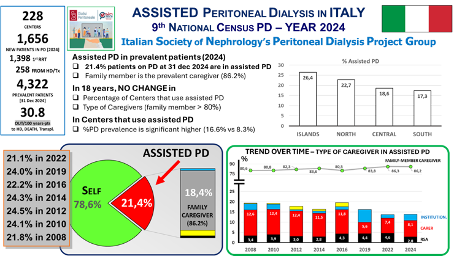
In the above-mentioned 221 Centers that submitted caregiver data, 904 patients were under assisted PD (21.4% of the total prevalence). The caregiver involved was mainly a family member in 779 cases (86.2%), a paid assistant / caregiver in 73 cases (8.1%), an institutional figure in 26 cases (2.9%), Nursing Home staff in 25 cases (2.8%) and only one case “other/unspecified” (0.1%) (Figure 1).

Figure 1. Assisted peritoneal dialysis in prevalent patients at 31/12/2024 and type of caregiver involved.

The overtime trend, starting from the first survey carried out in 2008, has excluded significant changes, both in the percentage of patients in assisted PD (Figure 1), which remains in the range of 21–25%, and in the type of caregiver involved (Figure 2), mainly a family member. Paid assistance seems to present a slight reduction compared to the period 2008–2016. The prevalence of assistance by an institutional figure or nursing home remains marginal and even in reduction in the last two census surveys.

Figure 2. Trend over time in family caregivers involved in assisted peritoneal dialysis (line) and trend over time of other forms of assisted peritoneal dialysis. Legend: Institutional: nurse (or other Institutional operators) at home; Carer: caregiver paid by the family; RSA: nursing home.


The national macro-area distribution of assisted PD is shown in Figure 3. The highest percentage of application was recorded in the islands Sardinia and Sicily.


Figure 3. Prevalence of assisted peritoneal dialysis in Italy in the four national macro-areas.
Figure 4. Differences between centers that use assisted peritoneal dialysis (AssPD YES) and those that do not use it (AssPD NO). Legend: Hemodialysis: column in red; Peritoneal Dialysis: column in blue.


Considering only the 180 centers that communicated data regarding hemodialysis patients in nursing homes, representing in total 22,355 dialysis patients, 753 dialysis patients (3.37%) were living in residencies, of which 20 patients under PD (2.66%) and 733 under hemodialysis (97.34%). From another point of view, based on prevalent PD patients (in total 3526 patients) only 0.57% were treated in nursing homes whereas 3.89% under HD (in total 18,829 patients) in nursing homes.

Discussion

Assisted PD in Italy affects approximately one-fifth of all PD patients, a percentage that has remained essentially unchanged over the last 20 years, and is mainly performed by a family caregiver.

Data on assisted PD use in other countries are scarce [3–5]. The only country with census data is France [6]. In other countries, data are limited to short-term observations, and mostly of a regional nature. The prevalence of assisted PD in Europe is characterized by a modest percentage of less than 10–15% of PD patients [3] with the exception of France where it concerns half of the incident PD patients. An important characteristic is the notable variability from country to country and in the same country from center to center, a variability also present in Italy where 18.1% of centers do not apply it and, among the centers with ≥15 PD patients, the median percentage of assisted PD application is 20.6%.

In other regional experiences, a variation over time is reported, generally linked to healthcare legislation or other incentives. In Italy, the stability of assisted PD application confirms the absence of measures in favor of assisted PD. However, the success of measures aimed at increasing PD depends mainly on the propensity to use PD. In countries with high PD prevalence, such as Canada or Scandinavian countries, measures to support assisted PD actually lead to an increase in its use [3]. In France, despite the major application of assisted PD, the prevalence of PD is even lower than in Italy.

The most interesting feature of assisted PD in Italy is its dependence on a family caregiver (86%), whereas in France a family member assisted only in 18% (home care nurse in 82%). Furthermore, in Italy the remaining 14% not directly assisted by a family member were, in the majority of cases, supported by a caregiver paid by the family. In Northern European countries, the prevailing model is that of home nurses depending on different reimbursement systems [3–5], whereas in Italy this aforementioned modality is limited to very few centers including less than 3% of patients in assisted PD.

Finally, PD in nursing homes in Italy concerns only a negligible percentage of patients, less than 1% of patients in assisted PD, compared to those in hemodialysis. This seems to be due to organization factors such as high staff turnover with the need for continuous training and scarcity of staff already burdened by high workloads.

Support measures might be provided as an economic incentive directly to the patient family. The only region where this has found wide application is Piedmont, in which a regional law applied since 2010 resulted in the highest percentage of assisted PD in Italy with a prevalence of 35.5%. Telemedicine [8], which has proven to be a valid support for PD, from the choice of treatment to training and management of complications, could also have a role in assisted PD. It might be used as permanent support for patients and/or caregivers, and for frequent checks or transport difficulties especially for those living in nursing homes.

Conclusions

Assisted PD in Italy is characterized by the predominant role of the family, in a landscape that has essentially unchanged over the last 20 years.


REFERENCES

  1.  Oliver MJ, Abra G, Béchade C, Brown EA, Sanchez-Escuredo A, Johnson DW, Guedes AM, Graham J, Fernandes N, Jha V, Kabbali N, Knananjubach T, Kam-Tao Li P, Lundström UH, Salenger P, Lobbedez T. Assisted peritoneal dialysis: Position paper for the ISPD. Perit Dial Int. 2024 May;44(3):160-170. doi: 10.1177/08968608241246447. Epub 2024 May 7. Erratum in: Perit Dial Int. 2024 Jul;44(4):294. doi: 10.1177/08968608241262001. PMID: 38712887.
  2. Neri L, Giuliani A, Heidempergher M, Zeiler M, Maxia S, Mastropaolo C, Viglino G, Marinangeli G, Cabiddu G. Peritoneal Dialysis in Italy: the 9th GPDP-SIN Census 2024. Twenty Years of Monitoring Peritoneal Dialysis. G Ital Nefrol. 2025 Aug 29;42(4):2025-vol4. doi: 10.69097/42-04-2025-02. PMID: 40923577.
  3. Brown EA, Ekstrand A, Gallieni M, Gorrín MR, Gudmundsdottir H, Guedes AM, Heidempergher M, Kitsche B, Lobbedez T, Lundström UH, McCarthy K, Mellotte GJ, Moranne O, Petras D, Povlsen JV, Punzalan S, Wiesholzer M. Availability of assisted peritoneal dialysis in Europe: call for increased and equal access. Nephrol Dial Transplant. 2022 Oct 19;37(11):2080-2089. doi: 10.1093/ndt/gfac193. PMID: 35671088; PMCID: PMC9585462.
  4. Reyskens M, Abrahams AC, François K, van Eck van der Sluijs A. Assisted peritoneal dialysis in Europe: a strategy to increase and maintain home dialysis. Clin Kidney J. 2024 Jun 5;17(Suppl 1):i34-i43. doi: 10.1093/ckj/sfae078. PMID: 38846415; PMCID: PMC11151117.
  5. Malho Guedes A, Punzalan S, Brown EA, Ekstrand A, Gallieni M, Rivera Gorrín M, Gudmundsdottir H, Heidempergher M, Kitsche B, Lobbedez T, Hahn Lundström U, McCarthy K, Mellotte GJ, Moranne O, Petras D, Povlsen JV, Wiesholzer M. Assisted PD throughout Europe: advantages, inequities, and solution proposals. J Nephrol. 2023 Dec;36(9):2549-2557. doi: 10.1007/s40620-023-01765-y. Epub 2023 Oct 19. PMID: 37856067; PMCID: PMC10703983.
  6. Registre de Dialyse Péritonéale de Langue Française – disponibile https://www.rdplf.org/resultatsrdplf/epidemiologie-dialyse-peritoneale.html
  7. Arbia G, Oradei M, Fiore A, Antonini D, Brunori G, Citterio F, D’Alonzo S, Vizzardi V, Gallieni M, Neri L, De Nicola L. HTA Assessment of Clinical-care Pathways: Peritoneal Dialysis Vs Hemodialysis – Content Summary. G Ital Nefrol. 2025 Oct 24;42(5):2025-vol5. doi: 10.69097/42-05-2025-04. PMID: 41184187.
  8. Maxia S, Giuliani A, Heidempergher M, Zeiler M, Mastropaolo C, Viglino G, Marinangeli G, Cabiddu G, Neri L. Controversial Aspects of Peritoneal Dialysis in Italy. Results of the First National Audit of PD. G Ital Nefrol. 2025 Oct 24;42(5):2025-vol5. doi: 10.69097/42-05-2025-11. PMID: 41184194.