Supplemento S86 - Editoriali

Vent’anni di esperienza nella dialisi peritoneale incrementale in Italia

Abstract

Introduction. Incremental peritoneal dialysis (Incr-PD) is a strategy to start PD when residual renal function is preserved.

Methods. We describe the Incr-PD practice across the last 20 years based on the 9th Italian PD Census utilizing a standardized definition of Incr-PD for both CAPD and APD (≤2 exchanges/day, ≤4 sessions/week).

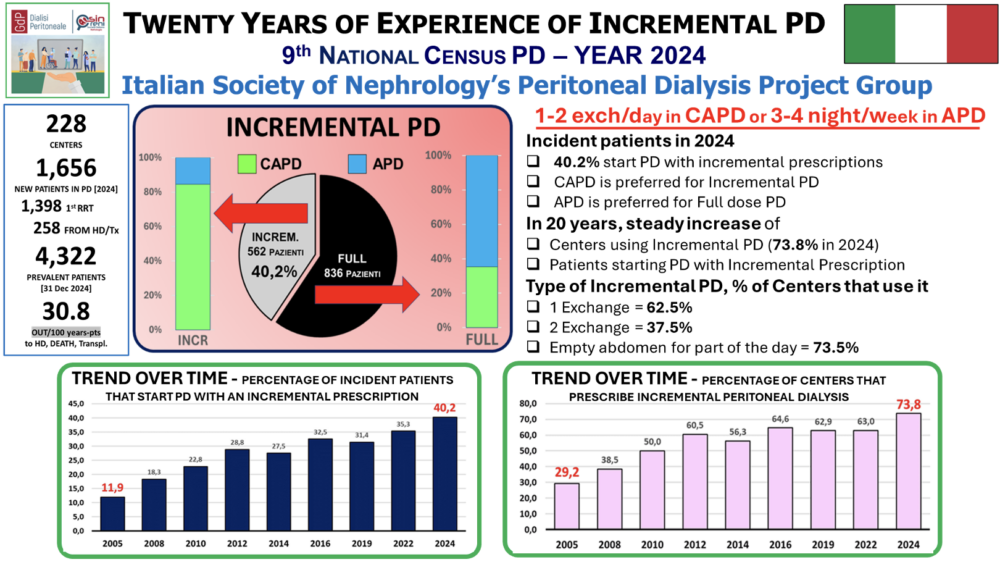
Results. In 2024, 1398 patients started PD, 40.2% on Incr-PD. 73.8% of the dialysis centers used Incr-PD. Incr-PD increased from 11.9% in 2010 to 40.2% in 2024. This is due to both the increase in the number of centers which started to use it (29.2% in 2005 to 73.8% in 2024) and in the number of patients treated with this modality in centers already confident with this modality (33.4% in 2005 vs 50.9% in 2024). Most of Incr-PD patients started with CAPD (84.5%) while APD was the preferred modality when full-PD is prescribed as first PD modality (64.7%). Regarding incremental CAPD, 62.5% of physicians start with one exchange, while 37.4% use two. In the latter case, only 26.2% prescribe two continuous exchanges with “the abdomen always full”. Incr-PD centers have higher incidence (21.7% vs 15.1%, p < 0.01) and prevalence (16.9% vs 12%, p < 0.01) of PD patients compared with those not using it. Conclusions. The trend confirms the success of Incr-PD, mostly in the form of CAPD. The increased Nephrologist’s confidence with Incr-PD allowed the expansion of this PD modality which is the mainstay of dialysis personalization.

KEYWORDS: peritoneal dialysis, incremental peritoneal dialysis, census report

Introduction

The concept of incremental peritoneal dialysis (Incr-PD) was introduced in the late 1990s within the National Kidney Foundation Guidelines for PD adequacy [1]. Those guidelines suggested to start an incremental approach if the combined, renal plus peritoneal, weekly Kt/V exceeds the target of 2, with the aim to progressively increase the dialysis dose when the residual renal function (RRF) deteriorates. This old definition is endorsed by the last proposed and recently published ISPD guidelines [2]. However, in the latter definition, authors referred mostly to the new concept of adequacy focused on individualized clearance, that is the one required to keep patient “concern well”, in a more holistic interpretation. In this view, Incr-PD must be intended as a strategy, more than a standard prescription, in which: 1) the initial PD prescription is less than full dose, 2) the initial peritoneal clearance alone is not able to reach the individual clearance target, but the combined peritoneal and renal clearance is enough to achieve it, 3) there is an intention to increase peritoneal dose as RRF declines.

This wide definition allows to include into the term “Incr-PD” a lot of PD schemes, which are variably prescribed around the world. In the last 30 years several observational studies [3–8], a single randomized controlled trial (RCT) [10], a secondary analysis of a RCT [11], and one systematic review [12], have been published on outcomes of Incr-PD. Overall, the evidence favoring Incr-PD compared to full-PD is weak, because studies are small and mostly retrospective. Moreover, studies are heterogenous in terms of definitions of Incr-PD, dialysis solutions used, RRF at dialysis start and duration of follow up, which makes it difficult to pool them together into metanalysis. Some studies seem to suggest that Incr-PD may have a positive effect on slowing the decline of RRF [6,7], others showed a reduction in peritonitis risk [4], an improvement in quality of life [5], and a better post transplantation outcome [9]. However, there is no evidence on strong outcomes such as mortality or technique survival. Generally, studies confirmed that an incremental approach is safe as no adverse event has been documented. Besides study results, Incr-PD has a favorable impact of patient’s acceptance of dialysis, it is less invasive into lifestyle and can reduce the disease burden at dialysis start. It is a glucose sparing strategy, less costly, and results in a reduced waste generation [13,14]. Taking together all these considerations, until more robust evidence will be published, PD scientific community believe to be rational to start with Incr-PD as first dialysis modality.

In Italy Incr-PD has been used since its first introduction. In fact, many of the observational studies contributing to the actual evidence about Incr-PD have been conducted by Italian groups [15–18].

In this study we report Italian experience on Incr-PD across the last 20 years, as a result of the analysis of the Italian PD Census.

Material and Methods

The Peritoneal Dialysis Census is regularly conducted by the Italian Peritoneal Dialysis Project Group (GDP-DP) of the Italian Society of Nephrology (SIN) since 2005. It is updated every 2 years thanks to the contribution of the Italian peritoneal dialysis centres which regularly enter data in a dedicated software or fill out an online questionnaire in the case that the dedicated software is unavailable. Data of the most recent 9th census, referred to 2024, has been published few months ago. Methods of data collection are extensively described there [19]. Briefly, aggregate data regarding dialysis modality (peritoneal or hemo dialysis) incidence, initial PD dose prescription (incremental or full dose), PD modality (CAPD or APD), assisted PD, PD modality switch, PD drop out, peritonitis, non-renal indication for PD (chronic heart failure or liver cirrhosis), peritoneal equilibration test (PET) type, home visits, encapsulating peritoneal sclerosis and peritoneal catheter type, are collected. In all editions, incidence was referred to the calendar year, that includes all patients starting dialysis between 1 January and 31 December of the analysed year. Prevalence is referred to patients treated at the end of year analysed (31 December). All dialysis facilities with at least one PD patient contribute to data collection, with a complete nationwide adhesion of the centers in which PD is available, in all editions, except for the year 2021 (referred to 2019) due to the Covid pandemic. Definition of Incr-PD remained unchanged through all editions for both CAPD (1-2 exchanges daily) and APD (≤4 sessions/week). Centers were divided, according to their attitude to Incr-PD prescription, into those who prescribe Incr-PD (Incr-Centers) and those who do not (Full-Centers). In the last edition a separated session, called national Audit, has been added, addressing topics of PD for which there is a known wide variability in the way clinicians’ approach them, including some elements of Incr-PD prescription [20]. It was asked if clinicians usually start incremental CAPD with one or two exchanges daily, and in case of two exchanges, if they are prescribed in a continuous way, with the “abdomen always full” or with “dry hours” including one additional manoeuvre to disconnect. Moreover, it was also asked which blood sample is commonly considered to calculate clearance in APD, the one in the morning, the one at midday or the mean value in between.

Due to the descriptive nature of the census, statistical analysis has been restricted only to group comparison applying Chi square Test when appropriate.

Results

In the last 9th Italian PD Census, 228 dialysis centres have been involved in data collection, for a total of 1398 incident PD patients. An Incr-PD prescription was used in 562 patients (40.2%), while 836 (59.8%) patients started with full dose peritoneal dialysis (Full-PD). The percentage of Incr-PD constantly increased over the years, from 11.9% in 2010, to the actual 40.2% (Figure 1).

Figure 1. Variation across time (from 2005 to 2024) of percentage of incident PD patients starting with incremental modality (Incr-PD).


Furthermore, we observed an increase in both the number of centers which started to use it (from 29.2% in 2005 to 73.8% in 2024, Figure 2) and in the number of patients treated with this modality in centers already confident with Incr-PD (from 33.4% in 2005 to 50.9% in 2024, Figure 3).

Figure 2. Variation across time (from 2005 to 2024) of percentage of Centers which start to use Incr-PD (Incr-Centres).
Figure 3. Variation across time (from 2005 to 2024) of percentage of patients starting with Incr-PD in Incr-Centers.


Continuous ambulatory peritoneal dialysis (CAPD) was the preferred modality for incremental start (Incr-CAPD) which has been used in 475 patients (84.5%) while only 87 patients (15.5%) started with incremental APD (Incr-APD) (p<0.01). On the contrary, APD was mainly used when Full-PD is prescribed as first PD modality (APD: 541 patients, 64.7% vs CAPD 295 patients, 35.3%, p<0.01). This practice gradually changed over time, as in 2005 CAPD was the preferred modality even for Full-PD (CAPD 686 patients 53% vs APD 585 patients, 47%), whereas only from 2012 onward the ratio between the two PD modalities inverted, starting to favour APD (Figure 4).

Figure 4. Trend of modality prescription of full dose PD from 2005 to 2024.


A total of 168 dialysis centres additionally provided data about hemodialysis (HD): this data was used to elaborate the prevalence of PD patients, which resulted in 4322 patients. 127 of 168 (75.5%) centers prescribe Incr-PD as first PD modality (Incr-Center), while 41 (24.5%) do not use it at all (Full-Center). Centers using Incr-PD have higher patient numbers compared with centers which do not use it, regarding incidence (21.7% vs 15.1%, p<0.01) and prevalence (16.9% vs 12.0%, p<0.01). The use of CAPD is not significantly different in centers using Incr-PD compared to those not prescribing it (32.4% vs 36.6% respectively).

In 2024 more patients in Incr-Centers switched PD modality, compared to Full-Centres (4.3 vs 2.2%, p<0.01), mostly from CAPD to APD (91.2%). In fact, APD is the preferred modality in prevalent PD patients, and it is significantly more used in centers not prescribing Incr-PD than in those using it (64.2% vs 54.1%, p<0.01). Centers prescribing Incr-PD utilize significantly more often assisted PD than those without incremental strategy (22.7% vs 15.6%, p<0.01), while no difference has been found regarding training modality and home visits (Table 1).

Incremental CAPD prescription has been investigated also through a national Audit to which 185 of 228 centers responded: 155 of 185 centres (83.8%) commonly use it, while 23 of 185 (12.4%) do not use it and 7 of 185 (3.8%) apply it only for refractory heart failure. In detail: 97 of 155 centers (62.5%) started with a single exchange, while 58 of 155 (37.4%) use two exchanges since the beginning. In the case of a 2-exchange prescription most of the physicians applied “dry hours”, while only 26.5% used continuous exchanges with the abdomen “always full”.

In the national Audit we also asked which timing of blood sampling is commonly used to calculate clearance in APD. Most of the centers (85.4%) responded the one in the morning, 8.6% the one at midday and only 5.9% the mean value in between.

Incidence (data taken from 228 centres)
Total incident PD patients (n) 1398
Incr-PD [n (%)] 562 (40.2%)
Full-PD [n (%)] 836 (59.8%)
Incremental PD
Modality Incr-CAPD [n (%)] Incr-APD [n (%)] P
n (%) 475 (84.5%) 87 (15.5%) <0.01
Full-PD
Modality CAPD APD P
n (%) 295 (35.3%) 541 (64.7%) <0.01
Centers habits (data taken from a total of 168 centres) *
n (%) Incr-Centers: 127 (75.5%) Full-Centers: 41 (24.5%) P
PD Incidence (%) 21.7 15.1 <0.01
PD prevalence (%) 16.9 12 <0.01
Prevalence
Total prevalent PD patients (n) 4322
Incr-Centers Full-Centers
Modality switch (%) 4.34 2.16 <0.01
APD (%) 54.1 64.2 <0.01
Assisted PD (%) 22.7 15.6 <0.01
Table 1. Results (referred to the Italian PD Census 2024)

* 168 centres insert both data regarding peritoneal and hemodialysis.

Discussion

In this paper we describe the Italian experience on Incr-PD during the last twenty years, obtained from the periodic Italian PD Census reports. Incr-PD prescription increased over time, from 11.9% in 2010 to 40.2% in 2024. This parallels on one side with an increase in number of patients starting Incr-PD in those centers already confident with this strategy and, on the other side, with an increase in the number of centers which start to use it de novo. This growing confidence towards Incr-PD may be due to the expanding evidence of its safety together with its hypothetical advantages such as better preservation of residual renal function [6,7], better post transplantation outcomes [9], reduced peritonitis risk, and better quality of life [5]. Undoubtedly Incr-PD is a glucose sparing strategy, less expensive and “more green” than full dose PD [13,14]. Above all, as underlined by the most recent guidelines on adequacy in PD [21], we are moving towards a more “person-centred”, “goal-directed” concept of dialysis adequacy, and Incr-PD may be considered as the mainstay of dialysis personalization.

In addition, the Italian PD censuses showed a progressive decrease in late referral PD patients which in 2024 was only 6.4% of incident PD patients [19]. This reflects the general extension of pre-dialysis care and a timely dialysis start with preserved RRF, which allows an incremental prescription.

The growing awareness of a more holistic view of adequacy, together with the aforementioned advantages of Incr-PD and the reduction of late referral patients, may have had a role in the success of Incr-PD observed over the years.

Nowadays, the use of CAPD is mostly linked to incremental prescription, while APD is largely used when full dose is necessary. This is not surprising since CAPD is simpler than a cycler and less intrusive if only 1 or 2 exchanges are prescribed, allowing patients to become gradually comfortable with dialysis. Moreover, icodextrin alone or as a part of an Incr-CAPD regimen, can be used as a glucose-sparing strategy [22,23]. On the contrary, APD requires a minimum of technical skills that are not always present in elderly patients, it is usually performed every other night, and the presence of a machine all night long, close to the bed might be perceived more intrusive [24]. In addition, the use of glucose-based solutions is obligated.

The ratio between CAPD and APD is reversed if we look at patients requiring full dose (FD), since most of them utilize APD. However, it has not always been this way, up to the early 2000’s CAPD was the preferred modality also for Full-PD. Since 2005 the ratio started to reverse and now APD is clearly more utilized than CAPD when Full-PD is prescribed. This is undoubtedly due to the technical evolution of cyclers which became progressively easier to use with simpler interface and less acoustic disturbance [25]. In addition, the recent advent of APD remote monitoring with the possibility to control and to modify the PD prescription remotely, favoured the further expansion of APD [26]. Given that, it is not surprising that Incr-PD patients changed PD modality more frequently than Full-PD, mostly from CAPD to APD, likely because of RRF decline and necessity to increase PD dose.

The distinct analysis of the “national Audit” showed that most of the Incr-Centers start with single exchanges, however when two exchanges are necessary, “dry hours” schemes are preferred to the “always full abdomen” regimen. Even if it is widely known that middle molecules clearance depends on the time of contact between dialysate and blood, and not on the number of exchanges [27], two continuous manual exchanges are not commonly used. This may be due to reduced tolerance to abdomen fullness during the day, when most of activities take place, determining an increase in intraperitoneal pressure and therefore of patient discomfort. Moreover, glucose absorption and negative ultrafiltration may be an issue, especially in patients with fast transport transfer rate. Even if there is increasing number of reports regarding the use of more than one icodextrin exchanges per day [28], its use is still approved for only once a day.

The “national Audit” also showed that most of the centers used the morning blood sample, that is the one soon after the end of dialysis, to calculate clearance in APD. However, since APD is an intermittent treatment, steady state cannot be assumed, thus using the morning sample to calculate dialysis clearances leads to an overestimation [29].

Even if in the most recent guidelines the concept of numerical clearance values has been downgraded in attempt to emphasize patient well-being more than numbers, adequacy indexes remain essential elements to understand how dialysis is going on, thus a correct calculation is fundamental.

Centres with attitude toward Incr-PD have both more incident and prevalent PD patients than those which do not use it. This may be related to the fact that Incr-PD may be more attractive for patients, who can choose a more flexible treatment, so that if Incr-PD is available, more patients choose it. However, it may also mean that centers with larger PD programs, apply Incr-PD because they are more experienced and are able to manage it. This is in line with the fact that Incr-Centers use also more assisted PD.

The study has an important limitation that is related to the nature of data collection which does not permit the analysis of outcomes and the duration of Incr-PD. This is a pure descriptive analysis that allow to focus on our practice but does not allow us to draw definitive conclusions.

Given that, there are some further results of the Italian PD Census that might be in some way related with the expansion of Incr-PD. For example, the reduction of the peritonitis rate (from 0.32 in 2005 to 0.16 episode / patient / year in 2024) and the drop-out rate, due to peritonitis (from 37.9% in 2005 to 21.8% in 2024).

Despite the results shown, the Italian PD Census confirms that generally the use of PD is quite static in term of prevalence (4234 vs 4322 patients, corresponding to 16.8% vs 15.9% patient per centre in 2005 and 2024 respectively) and that the mean duration of PD did not change during the observation time (from 32.8 to 31.3 months in 2005 and in 2024 respectively).

Conclusion

In this study we report the national data regarding Incr-PD updated to 2024. The trend over years confirms the success of incremental start, mostly in the form of CAPD, while APD is mostly used in prevalent PD patients. Centers who get used to prescribe Incr-PD are usually bigger with more incident and prevalent PD patients than those who do not, likely as they are more expert in the field and able to manage Incr-PD safely.

Data from national Audit confirm the uncertainty of nephrologists regarding some elements of Incr-PD prescription, highlighting the need for best practices for prescription.

The Italian PD Census is a great instrument which allows to understand the way Italian nephrologists practice PD and to observe its variation across time.

Abbreviations

PD: peritoneal dialysis; Incr-PD: incremental peritoneal dialysis; Full-PD: full dose peritoneal dialysis; CAPD: continuous ambulatory peritoneal dialysis; APD: automated peritoneal dialysis; Incr-Centers: incremental Centers; Full-Centers: full dose Centers; RRF: residual renal function.


References:

  1. NKF-DOQI clinical practice guidelines for peritoneal dialysis adequacy. National Kidney Foundation. Am J Kidney Dis. 1997 Sep;30(3 Suppl 2):S67-136. doi: 10.1016/s0272-6386(97)70028-3. PMID: 9293258.
  2. Blake PG, Dong J, Davies SJ. Incremental peritoneal dialysis. Perit Dial Int. 2020 May;40(3):320-326. doi: 10.1177/0896860819895362. Epub 2020 Jan 17. PMID: 32063212.
  3. Sandrini M, Vizzardi V, Valerio F, Ravera S, Manili L, Zubani R, Lucca BJ, Cancarini G. Incremental peritoneal dialysis: a 10 year single-centre experience. J Nephrol. 2016 Dec;29(6):871-879. doi: 10.1007/s40620-016-0344-z. Epub 2016 Aug 31. PMID: 27582136; PMCID: PMC5080315.
  4. Liu R, Ye H, Peng Y, Yi C, Lin J, Wu H, Diao X, Mao H, Huang F, Yang X. Incremental peritoneal dialysis and survival outcomes: a propensity-matched cohort study. J Nephrol. 2023 Sep;36(7):1907-1919. doi: 10.1007/s40620-023-01735-4. Epub 2023 Aug 21. PMID: 37603146.
  5. Naljayan M, Hunt A, McKeon K, Marlowe G, Schreiber MJ, Brunelli SM, Tentori F. Use of incremental peritoneal dialysis: impact on clinical outcomes and quality of life measure. J Nephrol. 2023 Sep;36(7):1897-1905. doi: 10.1007/s40620-023-01703-y. Epub 2023 Aug 29. PMID: 37644364.
  6. Lee Y, Chung SW, Park S, Ryu H, Lee H, Kim DK, Joo KW, Ahn C, Lee J, Oh KH. Incremental Peritoneal Dialysis May be Beneficial for Preserving Residual Renal Function Compared to Full-dose Peritoneal Dialysis. Sci Rep. 2019 Jul 12;9(1):10105. doi: 10.1038/s41598-019-46654-2. PMID: 31300708; PMCID: PMC6626037.
  7. Fernandes A, Matias P, Branco P. Incremental peritoneal dialysis: Is it better for preservation of residual kidney function and clinical outcomes? Clin Nephrol. 2023 Jan;99(1):11-17. doi: 10.5414/CN110958. PMID: 36472405.
  8. Lee SM, Min YS, Son YK, Kim SE, An WS. Comparison of clinical outcome between incremental peritoneal dialysis and conventional peritoneal dialysis: a propensity score matching study. Ren Fail. 2021 Dec;43(1):1222-1228. doi: 10.1080/0886022X.2021.1960564. PMID: 34396922; PMCID: PMC8381909.
  9. Domenici A, Comunian MC, Fazzari L, Sivo F, Dinnella A, Della Grotta B, Punzo G, Menè P. Incremental peritoneal dialysis favourably compares with hemodialysis as a bridge to renal transplantation. Int J Nephrol. 2011;2011:204216. doi: 10.4061/2011/204216. Epub 2011 Sep 15. PMID: 21941652; PMCID: PMC3173956.
  10. Yan H, Fang W, Lin A, Cao L, Ni Z, Qian J. Three Versus 4 Daily Exchanges and Residual Kidney Function Decline in Incident CAPD Patients: A Randomized Controlled Trial. Am J Kidney Dis. 2017 Apr;69(4):506-513. doi: 10.1053/j.ajkd.2016.08.019. Epub 2016 Oct 15. PMID: 27751610.
  11. Hayat A, Cho Y, Hawley CM, Htay H, Krishnasamy R, Pascoe E, Teitelbaum I, Varnfield M, Johnson DW. Association of Incremental peritoneal dialysis with residual kidney function decline in patients on peritoneal dialysis: The balANZ trial. Perit Dial Int. 2023 Sep;43(5):374-382. doi: 10.1177/08968608231175826. Epub 2023 May 31. PMID: 37259236.
  12. Xu S, Wu W, Cheng J. Comparison of outcomes of incremental vs. standard peritoneal dialysis: a systematic review and meta-analysis. BMC Nephrol. 2024 Sep 16;25(1):308. doi: 10.1186/s12882-024-03669-w. PMID: 39285336; PMCID: PMC11406953.
  13. Nardelli L, Scalamogna A, Cicero E, Castellano G. Incremental peritoneal dialysis allows to reduce the time spent for dialysis, glucose exposure, economic cost, plastic waste and water consumption. J Nephrol. 2023 Mar;36(2):263-273. doi: 10.1007/s40620-022-01433-7. Epub 2022 Sep 20. PMID: 36125629.
  14. Nicdao MA, Wong G, Manera K, Sud K, Tarafdar S, Jaure A, Chau K, Howell M. Incremental compared with full-dose peritoneal dialysis: A cost analysis from a third-party payer perspective in Australia. Perit Dial Int. 2026 Jan;46(1):54-62. doi: 10.1177/08968608251326329. Epub 2025 May 15. PMID: 40370087.
  15. De Vecchi AF, Scalamogna A, Finazzi S, Colucci P, Ponticelli C. Preliminary evaluation of incremental peritoneal dialysis in 25 patients. Perit Dial Int. 2000 Jul-Aug;20(4):412-7. PMID: 11007372.
  16. Neri L, Viglino G, Cappelletti A, Gandolfo C, Barbieri S. Incremental dialysis with automated peritoneal dialysis. Adv Perit Dial. 2003;19:93-6. PMID: 14763041.
  17. Viglino G, Neri L, Barbieri S. Incremental peritoneal dialysis: effects on the choice of dialysis modality, residual renal function and adequacy. Kidney Int Suppl. 2008 Apr;(108):S52-5. doi: 10.1038/sj.ki.5002601. PMID: 18379548.
  18. Neri L, Viglino G, Marinangeli G, Rocca AR, Laudon A, Ragusa A, Cabiddu G; Peritoneal Dialysis Study Group of Italian Society of Nephrology. Incremental start to PD as experienced in Italy: results of censuses carried out from 2005 to 2014. J Nephrol. 2017 Aug;30(4):593-599. doi: 10.1007/s40620-017-0403-0. Epub 2017 May 12. PMID: 28500518.
  19. Neri L, Giuliani A, Heidempergher M, Zeiler M, Maxia S, Mastropaolo C, Viglino G, Marinangeli G, Cabiddu G. Peritoneal Dialysis in Italy: the 9th GPDP-SIN Census 2024. Twenty Years of Monitoring Peritoneal Dialysis. G Ital Nefrol. 2025 Aug 29;42(4):2025-vol4. doi: 10.69097/42-04-2025-02. PMID: 40923577.
  20. Maxia S, Giuliani A, Heidempergher M, Zeiler M, Mastropaolo C, Viglino G, Marinangeli G, Cabiddu G, Neri L. Controversial Aspects of Peritoneal Dialysis in Italy. Results of the First National Audit of PD. G Ital Nefrol. 2025 Oct 24;42(5):2025-vol5. doi: 10.69097/42-05-2025-11. PMID: 41184194.
  21. Brown EA, Blake PG, Boudville N, Davies S, de Arteaga J, Dong J, Finkelstein F, Foo M, Hurst H, Johnson DW, Johnson M, Liew A, Moraes T, Perl J, Shroff R, Teitelbaum I, Wang AY, Warady B. International Society for Peritoneal Dialysis practice recommendations: Prescribing high-quality goal-directed peritoneal dialysis. Perit Dial Int. 2020 May;40(3):244-253. doi: 10.1177/0896860819895364. Epub 2020 Jan 21. PMID: 32063219.
  22. Jeloka T, Sanwaria P, Chaudhari L, Periera A. “Ico-Alone” single nocturnal exchange to initiate peritoneal dialysis in patients with residual renal function-Five year, single centre experience. Indian J Nephrol. 2013 Jul;23(4):276-9. doi: 10.4103/0971-4065.114496. PMID: 23960344; PMCID: PMC3741972.
  23. Agar BU, Sloand JA. Single Daily Icodextrin Exchange as Initial and Solitary Therapy. Perit Dial Int. 2018 Mar-Apr;38(2):119-124. doi: 10.3747/pdi.2017.00130. Epub 2018 Jan 31. PMID: 29386305.
  24. Domenici A, Giuliani A. Automated Peritoneal Dialysis: Patient Perspectives and Outcomes. Int J Nephrol Renovasc Dis. 2021 Oct 7;14:385-392. doi: 10.2147/IJNRD.S236553. PMID: 34675604; PMCID: PMC8504469.
  25. Giuliani A, Crepaldi C, Milan Manani S, Samoni S, Cannone M, De Cal M, Ronco C. Evolution of Automated Peritoneal Dialysis Machines. Contrib Nephrol. 2019;197:9-16. doi: 10.1159/000496302. Epub 2019 Apr 8. PMID: 34569509.
  26. Crepaldi C, Giuliani A, Milan Manani S, Marchionna N, Piasentin P, Ronco C. Remote Patient Management in Peritoneal Dialysis: Impact on Clinician’s Practice and Behavior. Contrib Nephrol. 2019;197:44-53. doi: 10.1159/000496317. Epub 2019 Apr 8. PMID: 34569511.
  27. Kim DJ, Do JH, Huh W, Kim YG, Oh HY. Dissociation between clearances of small and middle molecules in incremental peritoneal dialysis. Perit Dial Int. 2001 Sep-Oct;21(5):462-6. PMID: 11757829.
  28. Goffin E, Béchade C, Courivaud C, Bresson C, Heibel F, Stoléar JC, François K, Touré F, Aguilera D, Vrtovsnik F, Bammens B, Jadoul M, Devuyst O, Wilkie M, Bertrand A, Lobbedez T; DIDo Study Group. The Double-Icodextrin Dose Randomized Controlled Trial of a Double Icodextrin Dose for Older Patients on Incremental Continuous Ambulatory Peritoneal Dialysis. Kidney Int Rep. 2025 May 29;10(8):2585-2596. doi: 10.1016/j.ekir.2025.05.036. Erratum in: Kidney Int Rep. 2025 Oct 16;10(12):4318. doi: 10.1016/j.ekir.2025.10.001. PMID: 40814622; PMCID: PMC12347951.
  29. Friedlander MA, Rahman M, Tessman MJ, Hanslik TM, Ferrara KA, Newman LN. Variability in calculations of dialysis adequacy in patients using nightly intermittent peritoneal dialysis compared to CAPD. Adv Perit Dial. 1995;11:93-6. PMID: 8534747.